Reading Electrocardiograms
Liza Köster, BVSc(Hons), MMedVet(Vet), DECVIM-CA, EBVS, University of Florida

The author and Clinician’s Brief editorial team acknowledge the prior contribution of Henry W. Green III, DVM, DACVIM (Cardiology).
An electrocardiogram (ECG) is a record of the average electrical potential generated in the heart muscle at the body’s surface. The electrocardiograph amplifies and filters these small electrical signals and graphs this signal in voltage and time. These electrical signals are created by intracellular and extracellular ionic gradients that move across semipermeable membranes and result in cellular transmembrane action potentials.
Advantages
ECGs are easy to obtain and can expedite interventional therapy in instances of life-threatening arrhythmias, including high-grade atrioventricular (AV) block or ventricular tachycardia.
Disadvantages
Obtaining a resting ECG may be of insufficient duration to detect infrequent arrhythmias; a 24-hour ambulatory ECG (ie, a Holter monitor) thus improves diagnostic sensitivity, specifically when screening for familial cardiomyopathies and in cases in which an intermittent arrhythmia (eg, paroxysmal supraventricular tachycardia) is suspected. Longer recording devices are available, including an event monitor and an implantable loop recorder.
The sensitivity and specificity of an ECG is limited for predicting structural heart disease.
With continuous practice, reading ECGs can become facile and expedite decision-making for further diagnostic testing in small animal patients. This article is meant as a guide for stepwise assessment of ECGs.
Indications
ECGs are primarily used for detection and assessment of the normalcy of the heart’s rhythm or diagnosis or monitoring of patients with arrhythmias or conduction abnormalities. Strong indications for ECG in a dog or cat include the following:
Tachycardia or bradycardia detection during physical examination
Syncope or collapse
Confirmed cardiomyopathy on echocardiography or when suspected based on thoracic radiographs or cardiac biomarkers
Monitoring during sedation or anesthesia, as well as perioperative monitoring
Monitoring of patients involved in trauma or exposed to toxicity
Systemic illness requiring hospitalization
Electrolyte abnormalities
Pericardiocentesis
Drug monitoring, including antiarrhythmic therapy, for effect or adverse effects
Calculation of a mean heart rate in atrial fibrillation
ECGs have historically been used as an adjunct to detect cardiac chamber enlargement; however, echocardiography has shown that ECGs are neither sensitive nor specific for identifying chamber enlargement. Use for this purpose is thus no longer recommended.
Considerations
Waveforms & Intervals
When reading an ECG, familiarity with normal species variants is important. For example, most mammals (including dogs, cats, and humans) have a type-1 depolarization with a well-developed Purkinje fiber system and endocardial to epicardial depolarization; in contrast, birds and horses have a type-2b depolarization, in which epicardial to endocardial depolarization results in deflections opposite to most mammals. Physiologic shifts have been seen in mean electrical axis in specific breeds; for example, left shift of the mean electrical axis is reported in ≈40% of healthy Doberman pinchers.1
Recorded ECG waveforms and intervals that should be measured in the standard frontal plane leads (I, II, III, aVR, aVL, aVF) include the following (considerations for abnormal measurements are listed) (Figure 1).
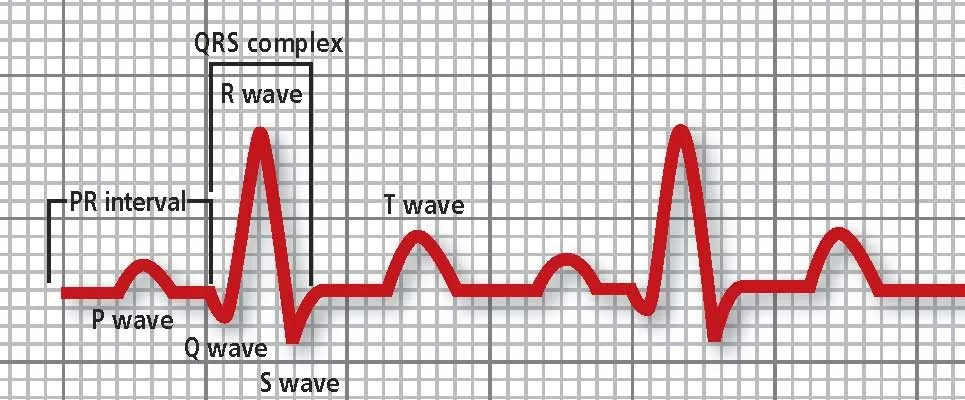
FIGURE 1 Various waveforms and intervals seen on an ECG
The entire P wave indicates atrial depolarization; the sequence is right (upstroke) followed by left (downstroke) atrial depolarization.
A tall P wave (>0.4 mV; ie, P pulmonale) represents right atrial enlargement.
A wide P wave (>0.04 seconds; ie, P mitrale) represents an enlarged left atrium.
A slight depression of baseline after the P wave (ie, Ta wave) may be visible and represents atrial repolarization. This is apparent in AV blocks.
The PR interval, which is measured from the start of the P wave to the start of the QRS complex, indicates the time of conduction from the sinoatrial node to the ventricles.
Conduction delayed by the AV node represents 75% of this interval.
Prolongation of this interval represents a first-degree AV block.
QRS is a complex of 3 waveforms that represents ventricular depolarization. All 3 waves may not be present at a given time.
Q wave is the first negative deflection.
R wave is the first positive deflection after the P wave and is typically the predominant waveform in left-facing leads (I, II, aVF, aVL).
The height of the R wave is measured from the top of the baseline to its peak.
Amplitudes exceeding the reference range (>3 mV) reflect left ventricular hypertrophy (eccentric, concentric, or mixed), as thickened walls produce greater potential.
A prolonged QRS duration (>80 ms) may be due to intraventricular conduction delay or left-sided heart enlargement.
QRS complexes with a W form (ie, splintering, notching) are designated as R’ or r’, in which the capital letter denotes the taller of the waves, and the lowercase letter denotes the lower amplitude deflection (Figure 2). This may reflect tricuspid dysplasia and thus be overrepresented in Labrador retrievers, in which this condition is familial.
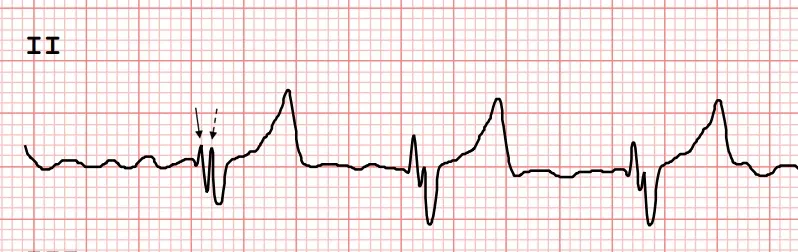
FIGURE 2 Lead II of a 6-lead ECG depicting a QRS complex with a splintered R wave; 2 positive deflections, named according to their amplitude (R wave is divided into R’ [solid arrow] and r’ [dashed arrow]), can be seen.
S wave is the first negative deflection after a positive deflection.
ST segment, the interval from the end of the QRS to the beginning of the T wave, is expressed as a positive (Figure 3) or negative amplitude (mV) by measuring the deflection from baseline (reference for baseline is estimated from the preceding PQ interval).
Abnormalities (ST segment elevation or depression) can reflect hypoxia or ischemia, electrolyte abnormality, drugs, and autonomic effect.

FIGURE 3 Lead II of a 6-lead ECG depicting sinus tachycardia in a patient in postoperative recovery after a liver lobectomy. The ST segment (dashed line) is elevated relative to the baseline (solid line), representing myocardial hypoxia. The ECG abnormalities normalized after analgesia and fluid deficits were addressed in this patient.
T wave, the first major deflection after the QRS, represents ventricular repolarization. Positive, negative, symmetric/asymmetric, and diphasic deflections are considered normal but should be consistent.
Amplitude abnormalities can occur with electrolyte abnormalities (eg, hyperkalemia), hypothermia, and heterogeneous dispersion of repolarization (eg, myocarditis, pericardial disease).
QT interval is measured from the onset of the Q wave to the end of the T wave and is the representation of the interval of the summation of both depolarization and repolarization of the ventricles.
QT interval is inversely related to heart rate, with the QT interval (ms) shortening with a faster rate (bpm), and could be corrected for heart rate but is rarely useful in dogs and cats; an exception would be monitoring for adverse drug effects of antiarrhythmic therapy.
QT interval should be roughly <50% of the preceding R-R interval. Prolonged QT intervals may reflect abnormal conduction from a genetic abnormality (eg, familial channelopathy), autonomic tone, or effect of drug therapy, including, serotonin antagonists, selective serotonin reuptake inhibitors, some antibiotic and antifungal drugs (eg, enrofloxacin), and class I and III antiarrhythmic drugs.
Evaluation
The Basics
Paper speed should be set to 50 mm/second or 25 mm/second depending on the heart rate. In general, 50 mm/second would be advised for cats and dogs with a higher heart rate, whereas 25 mm/second would be better for dogs and horses with a slower heart rate. In birds, 100 mm/second is ideal due to resting rates that can reach 600 bpm. If monitoring for cyclical changes in rate (eg, associated with breathing), a faster sweep speed (25 mm/second) is recommended.
One small block (1 mm) at 50 mm/second represents 0.02 seconds and at 25 mm/second represents 0.04 seconds.
Standard sensitivity is 10 mm/mV; however, sensitivity can be decreased to half (5 mm/mV) when complexes are too large or can be doubled (20 mm/mV) when complexes are too small.
Many machines use an autoscale function to adjust the sensitivity, which should be noted on the readout to allow amplitude assessment of the ECG complexes.
Which leads are provided should be noted. Standard lead II can be used for rhythm analysis.
Although heart disease in cats and dogs is common, advancements in treatment have enabled these patients to live longer and have a better quality of life. This resource on Heart Failure can help you navigate diagnosis and management of heart disease in your patients.
Calculating Heart Rate
Instantaneous heart rate calculation is convenient because it is fast and can be used to calculate the rate of arrhythmias of short duration or an instantaneous coupling interval/rate in the case of a premature beat. To perform this count, the number of millimeters between 2 consecutive R waves should be calculated and converted to seconds (measured mm/sweep speed mm/second), then one minute (60 seconds) should be divided by the interval(s) to give a rate (bpm) (Figure 4).
Instantaneous heart rate calculation is inaccurate with irregular rhythms.
For the standard heart rate calculation, the number of R waves in a 3-second interval in a 50 mm/second tracing or in a 6-second interval in a 25 mm/second tracing should be counted and multiplied by an appropriate integer to equal 60 seconds (ie, 3 seconds × 20; 6 seconds × 10). The interval (ie, 3 seconds at 50 mm/second, 6 seconds at 25 mm/second) is equivalent to 150 mm (150 small blocks) on a printed ECG, which is roughly equivalent to a standard ballpoint pen (with its cap on) measuring 14.9 cm (Figure 4). This calculation is helpful with gradual rate changes over time but tends to be inaccurate for very short-lasting arrhythmias.

FIGURE 4 Example of calculating an instantaneous (short line) versus average (long line) heart rate on lead II (rhythm lead) recorded at a sweep speed of 50 mm/second. The R-R interval (short line) is measured in millimeters (28 mm), converted to an interval in seconds (28 mm/50 mm/second = 0.56 seconds), and used to divide 60 seconds or 1 minute (60 seconds/0.56 seconds) to convert to a rate (107 bpm). The average rate (long line) represents a measurement of ≈15 cm, which on a 50 mm/second sweep speed is 3 seconds or one-twentieth of 1 minute. There are roughly 5 R-R intervals, which translates to 100 bpm (5 × 20 seconds).
Determining Overall Rhythm
With a regular rhythm, the R-R interval (ie, the time elapsed between 2 consecutive R waves) does not vary much (<10%) and, when sinus (ie, the sinoatrial node is pacing the heart), is referred to as a normal sinus rhythm (Figure 5).
Irregular rhythms display variation in the R-R interval.
A pattern that is cyclical and coincides with inspiration (faster) and expiration (slower) (ie, regularly irregular) indicates a respiratory sinus arrhythmia, which is common, considered normal in dogs, and a variant of sinus rhythm (Figure 6).
If the variation cannot be ascribed to the change in R-R interval associated with breathing, the cause is an arrhythmia (ie, irregularly irregular [eg, atrial fibrillation, sinus rhythm with atrial or ventricular premature complexes, sick sinus syndrome]).

FIGURE 5 Rhythm lead (lead II) depicting normal sinus rhythm with a regular R-R interval (<10% variation)

FIGURE 6 Rhythm lead (lead II) depicting a regularly irregular rhythm typical of respiratory sinus arrhythmi
Identifying Specific Waveforms, Timing, & Morphology
Possibility that artifacts (eg, patient movement, electrical interference, poor electrode contact with the patient) are interfering with the readout should be ruled out.
Whether the P wave, QRS complex, and T wave are present and related to each other by appropriately timed intervals should be assessed.
Knowing whether there is a P wave for every QRS complex and a QRS complex for every P wave, as well as whether there is an appropriate relationship based on the PR interval, may help with diagnosis.
For example, if a P wave without a QRS complex is present, the tentative diagnosis is second-degree AV block.
P waves generally look the same, except with atrial premature contractions (ie, P’ waves) and respiratory sinus arrhythmia, which can be accompanied by a wandering atrial pacemaker (Figure 7).
A QRS complex not preceded by a P wave, but following a pause, may represent a sinus node dysfunction with either a junctional or ventricular escape beat.
Following are considerations when discerning the origin of the arrhythmia.
A T wave must be present after every QRS complex, helping identify the QRS complex (sometimes working backward helps) and differentiating an artifact from a ventricular premature beat, which tend to have wide and tall T waves that are discordant to those normally generated by sinus beats.
P waves and T waves may overlap in atrial tachycardias, and the P’ wave may not be visible.
QRS complexes that appear earlier (premature; Figure 8) or later (escape rhythms; Figure 9) than expected should be noted.
The origin of these complexes can generally be discerned (with some exceptions) by the QRS morphology, with narrow complexes considered supraventricular and wide complexes considered ventricular in origin. An exception is a supraventricular beat conducted with aberrancy (conduction velocity is slowed), which is also a wide complex. A 12-lead ECG is necessary to discern the origin of a wide complex tachycardia.
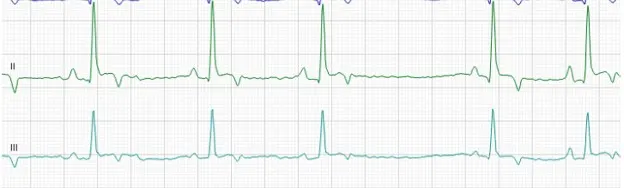
FIGURE 7 Lead II and III in a dog with a respiratory sinus arrhythmia and wandering atrial pacemaker. The morphology of the P wave changes with the R-R interval and thus vagal tone.


FIGURE 8 (left) ECG demonstrating normal sinus rhythm with a premature narrow complex, (ie, an atrial premature complex). The seventh QRS complex is earlier than expected, creating a pause after depolarization. (right) ECG demonstrating normal sinus rhythm with a muscle tremor artifact (low frequency, irregular baseline disturbance). A wide-complex premature beat (third QRS complex) represents a ventricular premature complex.
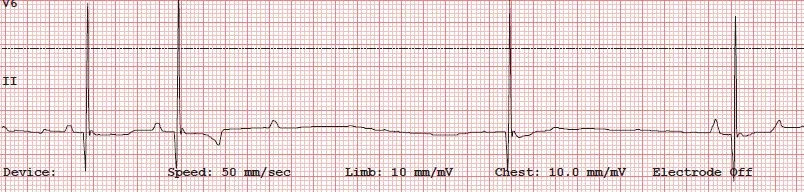
FIGURE 9 ECG demonstrating AV block. Two sinus beats are followed by a nonconducted P wave, and the pause is terminated by a narrow complex escape beat from a subsidiary pacemaker located in the junction.
Supraventricular (atrial or junctional) complexes demonstrate a normal, usually narrow, QRS morphology, while those originating in the ventricles typically appear wide and bizarre (eg, bundle branch block, conduction with aberrancy).
Premature rhythms can result in reduced stroke volume, depending on frequency and origin, and thus may compromise cardiac output. On examination, synchrony between the heartbeat and the femoral pulse (ie, pulse deficit) is lacking.
Escape rhythms are often life-saving depolarizations originating from a subsidiary pacemaker (junctional or ventricular Purkinje) that occur after sinus arrest, atrial standstill, or AV block and are thus considered secondary to some primary rhythm disturbances. Escape rhythms also occur during physiologic bradycardia from high vagal tone (eg, during sleep in brachycephalic breeds).
When a patient is critically ill, cost discussions can be especially tough, but finances can be the deciding factor in patient care. Set these conversations up for success with the following tips.
Provide a safe place for clients in a private room (not the waiting area), and have a seat together.
Acknowledge the client's financial strain (if applicable) and offer partnership in seeking solutions.
Ask permission before offering suggestions.
Present small amounts of information and pause to let the client absorb and formulate questions.
Include the rationale and benefit to the patient for the diagnostics and treatments you anticipate.