Recognizing & Managing Acute Respiratory Distress Syndrome in Veterinary Patients
Kristin Zersen, DVM, MS, DACVECC, Colorado State University
Ask the Expert: What factors indicate acute respiratory distress syndrome, and how should they be managed?
Acute respiratory distress syndrome (ARDS) is a clinical condition characterized by severe, diffuse pulmonary inflammation; acute respiratory distress; and hypoxemia due to pulmonary edema. Exudative and fibroproliferative phases of ARDS have been described.1,2 The exudative phase typically occurs in the first 7 days and is characterized by alveolar damage, formation of hyaline membranes, development of microthrombi, and activation of the innate immune system causing an influx of neutrophils. These changes result in hypoxemia and inflammation, which are characteristic of this syndrome.
Increased vascular permeability during the exudative phase leads to flooding of the alveoli and pulmonary interstitium with a high-protein transudate. The fibroproliferative phase occurs days to weeks after the initial event. In the initial stages of this phase, alveolar and interstitial fluid may be partially reabsorbed; however, the fluid will not be completely reabsorbed due to persistent increases in vascular permeability. Although alveolar epithelial cells begin to proliferate in this phase, extensive basement membrane damage from direct alveolar damage and formation of hyaline membranes in the exudative phase may result in development of interstitial and alveolar fibrosis; this does not occur in all patients.
Risk Factors for Acute Respiratory Distress Syndrome
Updated definitions for veterinary ARDS have been developed based on identified risk factors in limited veterinary literature.3 Probable risk factors were defined as those more strongly supported in the literature, including aspiration injury, systemic inflammatory response syndrome, sepsis, acute pancreatitis, aerosolized toxin inhalation, drowning, trauma, and smoke inhalation. Possible risk factors were defined as those with limited support or cases in which ARDS was not definitively diagnosed, including blood product transfusion and ventilator-induced lung injury.
Diagnostic Criteria for Acute Respiratory Distress Syndrome
Any patient with acute onset of respiratory distress (eg, tachypnea, increased respiratory effort [ie, dyspnea], hypoxemia) and a known risk factor should be screened for ARDS.
Current veterinary recommendations require 5 criteria for diagnosis of ARDS.3
Identified presence of a risk factor
Diagnosis of ARDS requires identification of a probable or possible acute predisposing risk factor.
Exclusion of cardiogenic causes as the origin for pulmonary edema
Left-sided congestive heart failure (CHF) and fluid overload must be ruled out as a cause of pulmonary edema. If either left-sided CHF or fluid overload is present, ARDS cannot be diagnosed.
Point-of-care ultrasound, thoracic radiography, echocardiography, and clinical evaluation can rule out CHF and fluid overload.
Timing confirmation of onset of respiratory signs
New or worsening respiratory signs (eg, tachypnea, progressively increasing respiratory rate, dyspnea) must develop within 1 week of the suspected clinical insult or risk factor.
Diagnosis of diffuse pulmonary infiltrates
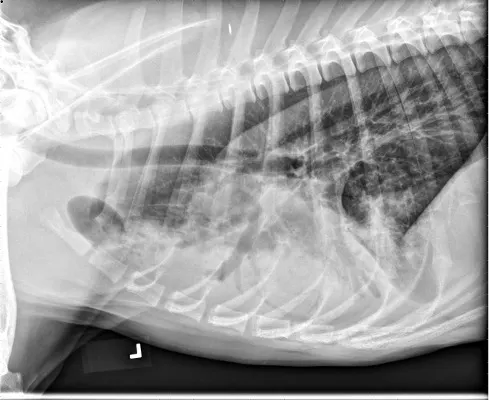
Diffuse pulmonary infiltrates must be documented via ultrasound (presence of B-lines and/or lung consolidation), radiograph (presence of an alveolar pattern), or CT (presence of an alveolar pattern).
Confirmation of hypoxemia
Patients are first stratified as to whether mechanical ventilation (positive end-expiratory pressure [PEEP] ≥5 cmH2O) has been implemented or whether the patient is not intubated and receiving supplemental oxygen or high-flow nasal oxygen (at least 1 L/kg/minute or >30 L/minute).
Hypoxemia must be documented using a ratio of partial pressure of oxygen in arterial blood to fraction of inspired oxygen (PaO2:FiO2) or oxygen saturation to fraction of inspired oxygen (SpO2/FiO2).
Mild to moderate ARDS is diagnosed in patients with a PaO2:FiO2 ratio of 100 to 300 or an SpO2/FiO2 of 150 to 315 (with SpO2 ≤97%).
Severe ARDS is diagnosed in patients with a PaO2:FiO2 ratio ≤100 or an SpO2/FiO2 ≤150 (with SpO2 ≤97%).
Although not required for diagnosis, evaluation of airway fluid collected via endotracheal or transtracheal wash or bronchoalveolar lavage can support diagnosis of ARDS. Airway fluid in a patient with ARDS includes neutrophilic inflammation with protein >2.5 g/dL.
Treatment for Acute Respiratory Distress Syndrome
No veterinary guidelines for ARDS treatment are available; however, the predisposing underlying disease should be treated. General supportive care (eg, GI support, analgesics, antimicrobials if there is reasonable suspicion of infection) should be instituted. Although inhaled medications have been suggested, no evidence supports their use. Mechanical ventilation is commonly required for marked hypoxemia and respiratory distress. In patients with less severe disease or in cases in which mechanical ventilation is not available, high-flow nasal oxygen therapy should be considered. Human medicine guidelines recommend mechanical ventilation with a lung protective strategy using low tidal volumes and high PEEP4; this is likely beneficial in veterinary patients as well. Prone positioning and neuromuscular blockers are also recommended in certain human populations4; these strategies may be considered in veterinary patients with ARDS, but evidence-based guidelines do not exist.
Most patients require IV fluids. A conservative fluid strategy is recommended in human medicine guidelines, as damage to the alveolar membranes results in significant risk for fluid extravasation into the alveolus and interstitium, contributing to worsening respiratory compromise.4 The goal is to avoid fluid overload while ensuring the patient is not hypovolemic (ie, intravascular fluid deficit).
Corticosteroids for treatment of ARDS is controversial in human literature, as strong evidence supporting use is lacking, and results are conflicting regarding improved survival benefit and increased risk for adverse effects and death.4
Patients with ARDS require intensive care, advanced monitoring that may include blood pressure and ECG monitoring, and frequent diagnostics. Hospitalization in a facility with these capabilities is thus recommended.
Prognosis for Acute Respiratory Distress Syndrome
In a retrospective study, the mortality rate of patients with ARDS was 84% in dogs and 100% in cats.5 The study included patients that underwent necropsy that did not confirm ARDS; the population was thus likely biased.5 In another study, the mortality rate of patients with ARDS was 92% in dogs and 80% in cats.6
Although veterinary literature supports a poor prognosis, treatment is still a reasonable consideration if an appropriate facility and expertise are available; however, pet owners should be educated about expectations and overall poor prognosis.