Scratching Behavior in Cats
Debra F. Horwitz, DVM, DACVB, Veterinary Behavior Consultation
Updated April 2026 by Amy L. Pike, DVM, DACVB, and Sameera Nalla, DVM; Animal Behavior Wellness Center, Fairfax, Virginia
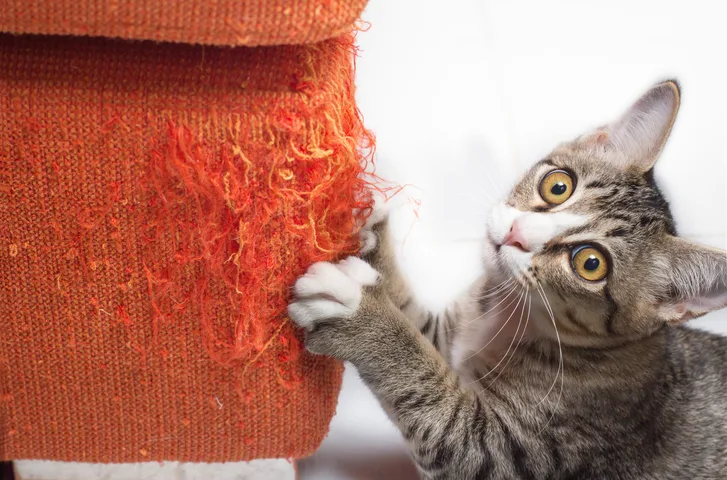
Handling destructive feline behaviors (eg, scratching furniture) can be difficult for cat owners. Helping owners understand feline marking, play, and stretching behaviors can help create an environment that meets a cat’s needs and avoids undesirable behaviors.
Why Do Cats Mark?
Marking is a normal and important social behavior for all animals. In cats, marking appears to be an innate behavior; cats do not need to be taught how to mark with their claws, and declawed cats still perform marking motions. Appropriate outlets for marking with the claws (ie, scratching) is considered a basic environmental need for cats.1
Cats commonly use several different types of social marking behaviors, including scent or visual marks that delineate territory, availability for mating, and other social functions. Scent marking is typically achieved through facial marking (ie, rubbing the sides of the face or body against objects) or urine marking.2 Claws can leave a visual mark, and glands on the feet leave a scent mark. Facial marking is not usually destructive or bothersome to cat owners, but claw marking can result in damage to household possessions.
Feline House Soiling
Solving feline house soiling requires a thorough examination of the patient and the home environment. Start by considering these common reasons cats miss the litter box
Marking Behavior
Scratching behavior in cats appears to fulfill multiple functions; in addition to leaving a visual and scent mark on objects, scratching behavior stretches the body and exercises the muscles and tendons involved in claw usage.3 Scratching is a highly motivated, species-typical behavior that also helps remove old claw sheaths and maintain claw health.4 The location where the cat scratches may depend on the function the cat is attempting to fulfill with scratching.
Outdoor scratching behaviors tend to occur along regularly traveled routes rather than at the periphery of the territory, leading to speculation that these marks serve as navigational markers. Scratching along regular travel routes and in prominent areas may also function as a visual display, particularly in the presence of other cats, and may increase when conspecifics are nearby.5
Loose claw sheaths are shed during scratching, and cats are often noted to engage in scratching upon awakening. Speculation on whether olfactory glands between the toes leave a noticeable scent is ongoing. No published studies have confirmed that cats sniff claw mark locations; however, the same claw marking sites are often used repeatedly by outdoor and indoor cats.
There is debate on whether scratching within the home may suggest anxiety or insecurity, occur more frequently at entrances and exits, function as a communication signal or displacement behavior, and/or increase in response to emotional states (eg, stress, fear, excitement).3,6,7 Scratching behavior indoors may tend to occur repeatedly at the same sites near where cats spend most of their time, leading to speculation that these marks provide reassurance and security to the marking cat rather than defining territory.8
Preferred Materials & Body Posture
Cats that live or go outdoors tend to scratch wooden objects (eg, boards, trees; Figure 1). Indoor cats may choose a variety of objects that are often located in prominent locations or pathways; furniture and carpets are common targets. Horizontal or vertical objects may be selected, with some cats preferring one or the other or both. Cats typically position the chest lower than the pelvic quarters, stretch out, and alternate paws to extend and retract the claws into the surface. On vertical surfaces, a cat may assume a different posture, with the chest higher than the pelvic quarters. Scratching can be vigorous or short; both result in scent and visual marks.
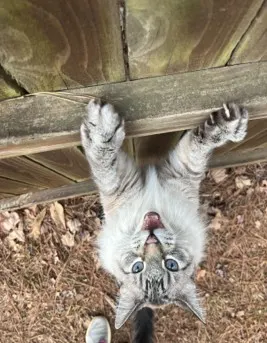
FIGURE 1 Cats using a wooden fence to stretch (A), as well as mark a tree (B-D).
A variety of scratching materials should be provided, as the type of material an individual cat prefers varies. Soft, workable materials (eg, soft bark, fabric) may enhance visual marking and allow effective claw engagement.5,9 Preferences also include orientation (vertical vs horizontal), height sufficient for full-body stretching, and stability of the scratching surface.7Scratching posts should be in a suitable location, stable and sturdy enough to not fall over, and tall enough to allow the cat to stretch fully and gain full purchase on the post. Some studies have indicated cats may prefer sisal rope or S-shaped cardboard scratchers, but no newer studies verify this desire.9,10
Changing Marking Behavior
Cats often establish a marking location that may not be preferrable to humans. Punishment can lead to secretive scratching, frustration, and anxiety. Environmental changes should instead be implemented.
Cats are more likely to use scratching posts placed in core areas of the environment where they eat, rest, and interact.11-13 If a scratching post is located in an area not usually frequented by the cat, moving the post to a more central area of social interaction may stimulate the cat to use the post and help make the current scratching location less desirable.
If a piece of furniture that has been consistently scratched is to be replaced, some of the material can be removed and placed on the scratching post. The refurbished post should be placed as close as possible to the location of the previous furniture, and the new furniture should be covered until the cat shows a well-established pattern of using the scratching post.
Making undesirable areas of scratching less attractive to the cat can be achieved by blocking access or covering with plastic, other fabric, or double-sided tape. A food-dispensing cat-scratching device (ie, Pavlov’s Cat [Figure 2]) rotates and dispenses food into a bowl when the device is scratched.
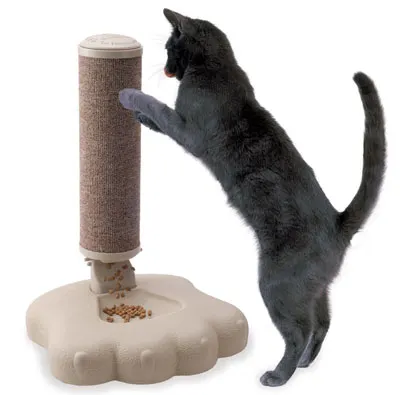
FIGURE 2 Pavlov’s Cat device
Providing multiple scratching options that are distributed throughout the home is especially important in multicat households to reduce competition and stress.1,4
Remote punishment devices to scare the cat (making the location undesirable to the cat) are available but not recommended, as evidence on the efficacy of these types of interventions is lacking. In addition, the American College of Veterinary Behaviorists does not condone the use of punishment-based techniques that rely on pain, force, fear, or intimidation.14 Punishment-based learning is associated with increased fear, anxiety, stress, and arousal and can exacerbate existing behavior concerns or contribute to the development of new ones.9,15
Treatment at a Glance
Scratching posts should be located in a central area of social interaction and/or as close as possible to the item the cat is currently scratching.
Material can be salvaged from previously scratched items to cover a scratching post.
Unwanted areas of scratching can be made less desirable by being blocked off or covered with plastic, other fabric, or double-sided tape.
Punishment should not be used; instead treats and/or attention should be given for using scratching posts, or a food-dispensing cat-scratching device can be provided.
Exploration can be encouraged by placing catnip or treats on or near scratching posts.
Multiple surfaces with varying textures, orientations, and locations should be provided to meet individual preferences.
Environmental enrichment that includes opportunities for climbing, hiding, resting, and scratching should be provided.
Key resources (ie, food, water, litter boxes, scratching areas) should be distributed throughout the home, especially in multicat environments.
Scratching behavior should be monitored for indications of stress, social conflict, or inadequate environmental resources.
Conclusion
In most cases, a cat can be taught to use a scratching post rather than an owner’s possessions. Caregivers should also consider working with a credentialed, force-free, positive reinforcement cat trainer. Cats typically respond well with time and effort.
Achieving Cat Owner Compliance With Enrichment Recommendations
Inadequate environmental enrichment can be a factor in many feline behavior disorders, so it can be frustrating when pet owners appear reluctant to make the needed lifestyle changes. Find out the different types of obstacles that stand in the way of compliance and get tips on how to meet the owner halfway in this article on Achieving Cat Owner Compliance With Enrichment Recommendations.