Outcomes of Blunt Thoracic Trauma in Dogs
Andrea Armenise, DVM, Cardiology and Abdominal Ultrasonography Advisor, Bari, Italy
In the Literature
To A, Hall J, Mallard M, Kundu D, Mochel JP, Walton RAL. Retrospective evaluation of treatment and survival of blunt trauma associated pneumothorax in dogs: 89 cases (2018-2022). J Vet Emerg Crit Care. 2025;35:546-550. doi:10.1111/vec.70035
The Research …
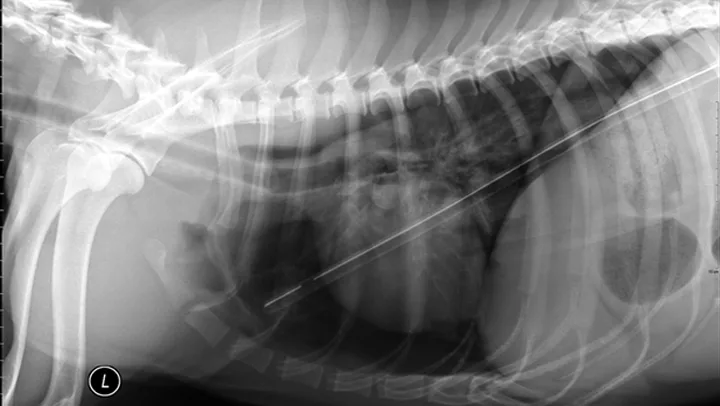
High-speed impact to the chest wall can result in blunt thoracic trauma and is typically caused by vehicle crashes, high-rise syndrome, or intentional injuries.1 Pneumothorax can develop in 30% to 47% of these traumatic injury cases, with presentations ranging from clinically insignificant to cardiopulmonary arrest, depending on the severity of the impact.1-5
This retrospective study evaluated clinical course, therapeutic intervention, and survival to discharge in dogs diagnosed with blunt trauma–associated pneumothorax (n = 89) from medical records of a large private practice hospital and a veterinary teaching hospital. The relationship between animal trauma triage (ATT) and modified ATT scores (including neurologic, perfusion, and respiratory categories) with pneumothorax-specific intervention and survival to discharge was also assessed.
Findings showed that 52 (58%) dogs were observed and did not receive direct intervention for pneumothorax and 37 dogs (42%) received a pneumothorax-associated treatment. Thoracocentesis was the first-line treatment in a majority of the 37 cases in which intervention was instituted and the only treatment provided in 22 (59%) cases. Of the 15 (41%) dogs that had a thoracostomy tube placed, 11 (73%) had at least 1 previous thoracocentesis. Seventy-eight (87.6%) dogs survived to discharge, 10 dogs (11%) were euthanized, and 1 dog (1%) experienced cardiopulmonary arrest.
Placement of chest tubes and survival to discharge were correlated with modified ATT; however, no significant association was observed between the ATT score and the need for a particular pneumothorax intervention or survival.
… The Takeaways
Key pearls to put into practice:
Almost 90% of patients in the current study survived to discharge. The majority did not receive specific pneumothorax intervention, indicating that a conservative strategy with active observation is appropriate in cases with no clear clinical indications. These findings are similar to those of a human observational study on posttraumatic pneumothorax that reported clinical surveillance alone was sufficient to manage 85% of hemodynamically stable patients without the need for additional specific therapeutic interventions.6
Thoracocentesis should be the first option considered if treatment for pneumothorax is needed. The Seldinger technique for chest tube placement can be considered if continuous air aspiration is needed.
ATT may be unreliable in patients with mild intensity trauma; however, modified ATT may provide a useful indication, particularly during initial assessment, for application of chest tubes and estimation of the risk for nonsurvival.
You are reading 2-Minute Takeaways, a research summary resource presented by Clinician’s Brief. Clinician’s Brief does not conduct primary research.