Accommodating Clients With Disabilities
Beckie Mossor, RVT, 3K9 Working Dogs, Inc.
Disability is a term that encompasses all impairments, activity limitations, and participation restrictions. According to the World Health Organization (WHO), Disability is thus not just a health problem. It is a complex phenomenon, reflecting the interaction between features of a person’s body and features of the society in which he or she lives. Overcoming the difficulties faced by people with disabilities requires interventions to remove environmental and social barriers.1
The WHO estimates that >1.3 billion people worldwide experience a disability.1 This is a significant percentage of the population, and veterinary clinics should ensure necessary accommodations are available for clients with disabilities. Environmental and social barriers often exist in veterinary practice. Taking steps to ensure all clients receive the same level of comfort and accommodation, regardless of ability, is essential. The way clients are treated in the clinic can directly affect their understanding, adherence to treatment recommendations, and overall satisfaction with their pet’s care.
Reasonable Accommodations
The Americans with Disabilities Act requires reasonable accommodations be made for all people with emotional, physical, and mental disabilities.2 Most clinics in the United States are in compliance with building code structures required for accessibility, but more can be done to ensure all visiting clients feel comfortable and safe.
Reasonable accommodations should be part of the clinic culture, including appropriate terminology, etiquette, communication of instructions, and appointment accommodations.
Appropriate Terminology
Use of inoffensive terminology is an essential aspect of good social skills and should be considered when addressing clients with disabilities. Some clients may prefer person-first language (eg, person with a disability) rather than identity-first language (eg, disabled person), but this may not be the case with every client or disability. Online resources are available for guidance on use of inclusive language in signage, handouts, and/or team training (see Suggested Reading). Inclusive language creates an environment that welcomes and establishes a sense of belonging rather than one that divides or offends.
Terms like person without disabilities can be used when referring to someone without a disability. The phrase, normal person, should not be used. A person can easily overlook common underlying meanings even when they do not intend to be unkind, but those with disabilities may feel such statements are unsympathetic.
General Etiquette Tips
Avoid unnecessary touch, and clearly announce any intended physical contact.
Respect personal space, including medical equipment.
Create a judgement-free environment so clients feel safe to request special accommodations, and remember that many disabilities are invisible.
Tips for Accommodations in the Clinic
Many accommodations are possible, but following are a few basic steps that can help ensure clients feel safe, comfortable, and that their needs are met.
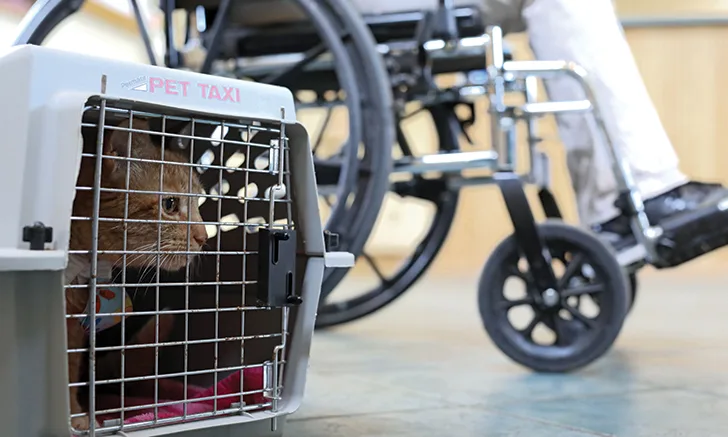
Provide tables and hands-free resources. Small tables should be positioned beside chairs so cat carriers can be placed safely on a table rather than on the floor where they can become tripping hazards and/or may be difficult to set down or pick up. Carabiners, commercial leash-holding devices anchored to the desk, small boarding cages at the front desk, or even a dedicated team member who can act as a concierge and help with check-in and check-out can provide a hands-free checkout.
Be prepared for emergencies. Team members should be trained in human cardiopulmonary resuscitation, an automated external defibrillator should be accessible, and emergency contacts should be kept for clients. The clinic’s street numbers and signage should be clearly visible to vehicles responding to a 911 call. Team members should remain aware of their surroundings and ensure any safety hazards are addressed.
Record special requests. Notations can be made in client records to remind team members of accommodation requests or important information regarding client or patient interactions. These notations should only be viewable by team members treating the patient, as this type of information is confidential.
Change appointment scheduling. Appointments made during quiet times (eg, during procedures, after morning surgeries) can offer less noise and distraction. Extended appointments can be considered if a client needs additional time.
Provide choices. Some clients may prefer to wait in the waiting room, in an examination room, outside, or in their car. Offering options can create a culture of flexibility and understanding.
Talk openly about preferences. Although asking an individual (either client or team member) if they have a disability or for a specific diagnosis is illegal, a person may disclose this information voluntarily. Asking questions such as, How can we make your visit more comfortable?, Do you have any accommodation requests?, or Is there any other important information you feel we should know? on new client forms gives clients the opportunity to disclose their preferences or needs.
Make forms accessible. Client forms should contain simple language and be available in different formats (eg, dyslexia-friendly fonts, digital).
Appointments
Understanding the need for flexibility (eg, because of an inability to drive to the clinic, inflexible schedule due to medication or human medical appointments) is important. Some individuals may experience mental or emotional distress while in the clinic (see The Client Experience).
The Client Experience
These elements affect the client experience for all clients.
Move through the clinic as if you were a client. Consider what the experience would be like for someone with a visual or physical impairment or an emotional, mental, or sensory disability.
Can you move easily through the rooms?
Are there any tripping or falling hazards?
Is the lighting adequate?
Sit in an examination room for 10 minutes, look around the room, and listen.
Is there something to look at?
Is it noisy?
How is the room temperature?
Sit in the client’s chair. Check the seating height; many practices have low seating, which can be challenging or inaccessible for some clients.
Is it comfortable?
Are benches or chairs without arms available for clients in larger bodies?
Educational materials and important instructions that account for learning differences should be provided. There are 7 types of learning styles (ie, visual, physical, aural, verbal, logical, social, solitary) unrelated to ability or intelligence.3 Providing clients with multiple means of receiving information can appeal to people with any learning style. Clients can perceive the value of the information and, in turn, the value of their visit.
Take Action
Always accommodate the needs of clients with disabilities; taking steps to better serve these clients can result in better service for all clients.
Ensure team members are familiar with inclusive terminology (eg, clients have a disability; they are not disabled) and understand that although terminology preferences may evolve, the goal is to create a culture of safety and respect.
Provide educational materials that appeal to every kind of learning style.
Conclusion
Providing extra accommodations may seem time-consuming, but time will be saved in the long run because information does not have to be repeated. Increased client satisfaction and compliance may result because clients are more likely to understand information they are given when communication is tailored to their needs. Satisfied clients lead to an improved bottom line.
Understanding, tolerance, and acceptance of every client is vital. Creating an environment in which every client feels safe and respected, whether or not they experience a disability, is essential for a positive practice culture and business success.