Vitamin D Metabolism and Canine Chronic Kidney Disease
Valerie J. Parker, DVM, DACVIM, DACVN, Associate Professor – Clinical, Department of Veterinary Clinical Sciences, The Ohio State University Veterinary Medical Center, United States of America
Vitamin D metabolism and hormonal influences
In many species, the biosynthesis of vitamin D begins with exposure to UV light, wherein 7-dehydrocholesterol is transformed to previtamin D3. Dogs and cats are distinct from humans and many other species in that they have ineffective synthesis vitamin D3 in the skin, likely because of high activity of 7-dehydrocholesterol-Δ7-reductase.1 For this reason, dogs and cats require dietary supplementation with vitamin D to meet nutritional requirements. There are two dietary forms of vitamin D: cholecalciferol (vitamin D3), which typically comes from animal food sources, and ergocalciferol (vitamin D2), which typically comes from plant sources. Cats may not utilize ergocalciferol as efficiently as cholecalciferol; dogs, however, have the ability to utilize both dietary forms equally.,
Dogs and cats require dietary supplementation with vitamin D due to ineffective synthesis of vitamin D3 in the skin.
Dietary vitamin D is supplied in commercially available dog and cat foods in the form of various ingredients (e.g., organ meat or oily fish products) and supplemental cholecalciferol. Once ingested, it is transported to the liver via the portal system and intestinal lymphatics (Figure 1). This process requires digestive enzymes, chylomicrons, bile acids, vitamin D binding protein, or transcalciferon. After cholecalciferol is transported to the liver, it is hydroxylated by 25-hydroxylase to form 25(OH)D (also known as calcidiol or calcifediol), which binds to vitamin D binding protein in the circulation. With a half-life of approximately 2 to 3 weeks, 25(OH)D is thought to be the most reliable indicator of systemic vitamin D status in humans.2
Then, 25(OH)D is hydroxylated via 1α-hydroxylase to form 1,25(OH)2D (the most active naturally occurring vitamin D metabolite; also known as calcitriol), which affects many target cells via a vitamin D receptor–mediated mechanism. Calcitriol binds to the vitamin D receptor much more readily (approximately 500 times as readily) than does vitamin D3 or 25(OH)D. This activation of 1,25(OH)2D occurs predominately in the kidneys, however, it also occurs in other tissues that express 1α-hydroxylase. Although the exact mechanism has not been completely elucidated, 1α-hydroxylase activity is tightly regulated by serum concentrations of calcium, PTH, 1,25(OH)2D, and FGF-23 and activity of the enzyme Klotho. Within cells, 1,25(OH)2D can promote or suppress gene transcription and expression. Both 25(OH)D and 1,25(OH)2D are inactivated via 24-hydroxylase to form 24,25(OH)2D and 1,24,25-trihydroxyvitamin D, respectively) and other metabolites (eg, 25[OH]D-23,23 lactone) that are excreted in the urine and bile.3,4
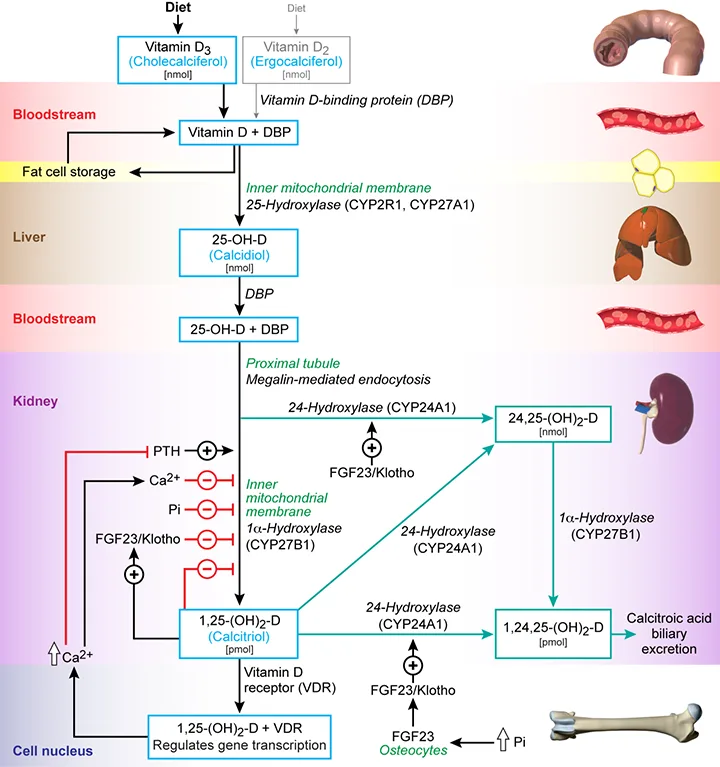
Comprehensive overview of vitamin D metabolism, starting with dietary intake and progressing through hepatic and renal transformation. Also notice the influences of phosphate (Pi), ionized calcium (Ca2+), FGF-23, Klotho, and PTH. CYP = Cytochrome P450. (Reproduced with permission of The Ohio State University.)
Vitamin D roles
Classically, vitamin D is known for its influence on calcium-phosphorus homeostasis via the bone-parathyroid-kidney axis. However, vitamin D has been found to have multiple other effects throughout the body, given the wide variety of cells that express the vitamin D receptor. Actions induced by vitamin D receptor activation in humans include differentiation of immune cells, reductions in inflammation and proteinuria, increases in insulin secretion, and improvement of hematopoiesis. In people, vitamin D deficiency (hypovitaminosis D) has been associated with a multitude of clinical syndromes, including kidney disease, cancer, obesity, asthma, intestinal disease, diabetes mellitus, hypertension, and infectious diseases. Vitamin D status also affects various disease conditions in dog and cats. Vitamin D metabolites have been measured in dogs with several forms of kidney disease, including acute renal failure,5 CKD,5-9 and proteinuric kidney disease.b
There are several mechanisms by which vitamin D metabolism can be disrupted with kidney disease, including decreased dietary intake of vitamin D, decreased enzymatic conversion from cholecalciferol to 25(OH)D in the liver,10 decreased activation via 1α-hydroxylase from 25(OH)D to 1,25(OH)2D, and increased inactivation of 25(OH)D and 1,25(OH)2D.11 With proteinuria, there are additional potential mechanisms to consider, including urinary loss of vitamin D binding protein (with 25[OH]D and 1,25[OH]2D bound to vitamin D binding protein) and decreased endocytosis of 25(OH)D into renal cells because of decreased megalin expression in the proximal renal tubules.12 Furthermore, inflammation may act to reduce 25(OH)D concentrations.13
Vitamin D metabolism is disrupted in dogs with CKD, resulting in lower 25(OH)D and 1,25(OH)2D serum concentrations.
In several studies, it has been reported that dogs with CKD have lower 25(OH)D and 1,25(OH)2D concentrations compared with concentrations in control dogs.5-9 Vitamin D metabolites have also been shown to correlate with stage of kidney disease (determined via International Renal Interest Society criteria), decreasing with increasing IRIS stage.7,9 In some studies, despite differences between CKD and control dogs, many dogs had 25(OH)D and 1,25(OH)2D concentrations within reference limits.5,6 One possible explanation for this is the relatively large reference ranges used in the earlier studies5,6 or the differences in laboratory techniques utilized.
One of the consequences of CKD is development of secondary hyperparathyroidism and CKD-induced mineral and bone disorders.14-16 Plasma FGF-23 concentrations are increased in cats and dogs with CKD.17,18 Concentration of FGF-23 was negatively correlated with 25(OH)D, 1,25(OH) 2D, and 24,25(OH)2D concentrations in dogs with CKD and with survival duration in cats and dogs with CKD.<sup19,csup> For several decades, calcitriol treatment has been recommended to reduce PTH concentrations and improve quality of life in dogs and cats with CKD.<sup20,21,dsup> However, prospective, controlled clinical studies are needed to determine the manner in which supplementation with various forms of vitamin D influences FGF-23 concentrations, Klotho expression, vitamin D repletion, quality of life, preservation of renal function, and survival.
Finally, dogs with acute renal failure had significantly lower 25(OH)D and 1,25(OH)2D concentrations compared with concentrations in control dogs, but most (7/10) of the dogs with acute renal failure had concentrations within reference limits.5 These findings could be attributable to acute inflammation or critical illness13,22 or could have been spurious results. Proteinuric dogs have significantly lower 25(OH)D, 1,25(OH)2D, and 24,25(OH)2D concentrations than do control dogs.b This relationship has been definitively established in proteinuric people, and vitamin D receptor activators are frequently prescribed to reduce proteinuria.12,23
Vitamin D supplementation and toxicosis
Numerous studies have identified decreased concentrations of vitamin D metabolites in dogs and cats with various diseases, however, it has not yet been determined whether these animals should receive supplemental vitamin D or vitamin D metabolites, and if so, the manner for providing them. Potential options include vitamin D2 (ergocalciferol), vitamin D3 (cholecalciferol), calcidiol, calcitriol, or other vitamin D receptor activators (e.g., paricalcitol). The goal of supplementation with any form of vitamin D should be to increase serum 25(OH)D +/- 1,25(OH)2D concentrations and improve outcomes specific to the disease being managed (e.g., reducing proteinuria or improving the survival rate or duration). The form of supplemental vitamin D administered, half-life of the product, and potential for toxic effects may differ, thus caution must be exercised, and treated animals must be monitored closely.
Starting with dietary vitamin D3 intake, canine renal diets currently provide a range of approximately 17-44 IU per 100 kcal. (personal communication, Hill’s, Purina, Royal Canin) The 2017 Association of American Feed Control Officials (AAFCO) minimum and maximum for vitamin D3 for canine adult maintenance are 12.5 and 75.0 IU/100 kcal. There does not seem to be a clear relationship between dietary vitamin D3 intake and subsequent serum 25(OH)D concentrations; thus, simply increasing D3 intake does not seem like the way to improve vitamin D status.9,25
A modified-release formulation of 25(OH)De was approved by the FDA in 2016 for treatment of humans with advanced stages of CKD. It was recently reported that providing supplemental 25(OH)D to dogs rapidly and efficiently increased serum 25(OH)D concentrations.24 Additional studies are necessary to elucidate appropriate dosing recommendations. As discussed above, there is some evidence to support supplementation with calcitriol; however, there cost, monitoring, and potential for toxicity are sometimes limiting factors for pet owners.
Vitamin D toxicosis is most commonly diagnosed after the development of hypercalcemia and a subsequent risk for acute kidney injury and soft tissue mineralization. Development of hypercalcemia as a result of vitamin D toxicosis is a relatively late finding. Several factors influence the potential for vitamin D toxicosis, including lipophilicity, affinity of vitamin D metabolites for vitamin D binding protein, and rates of metabolite synthesis and degradation. Its fat solubility is a primary reason that vitamin D has a long whole-body half-life of approximately 2 months. Half-lives for 25(OH)D and 1,25(OH)2D are approximately 2 to 3 weeks and 4 to 6 hours, respectively.26,27 Vitamin D toxicosis in human that results in hypercalcemia is thought to occur when 25(OH)D concentrations exceed 100 to 150 ng/mL. In studies of various animal species (rats, cows, pigs, rabbits, dogs, and horses), plasma 25(OH)D concentrations associated with hypercalcemia exceed 150 ng/mL.26
Conclusions
Alterations in vitamin D metabolism are abundant in canine kidney disease; yet little attention has been paid to how to best address these derangements in veterinary medicine. There is promising research underway that aims to answer some of the lingering questions, namely, 1) how do we best approach hypovitaminosis D? and 2) what ultimate effects can we make on progression of disease and survival?