Top 4 Orthopedic Tools for Veterinary Fracture Repair
Sponsored by Arthrex Vet Systems
Although some general veterinary practices refer all orthopedic surgeries to a specialist, many offer at least some level of orthopedic service, including surgical fracture repair. Certain fractures can be effectively managed with external coaptation such as casting or splinting, whereas others require surgical fixation to achieve proper alignment and healing. Determining the approach appropriate depends on factors such as fracture type, location, stability, and patient size.
For practices interested in offering surgical fracture repair, proper training and experience are critical. Surgical fixation requires a solid understanding of orthopedic principles, familiarity with instrumentation, and the ability to manage potential complications. Offering orthopedic services requires stocking the necessary materials to perform these procedures. If a practice offers surgical fracture repair, 4 essential categories of equipment should be kept in stock. With these, the veterinary team can successfully manage many fractures that are commonly encountered in general practice.
1. Intramedullary Pins & Cerclage Wires
Intramedullary (IM) pins combined with cerclage wire are easy to place and cost-effective for clients, making them the most common surgical fracture repair option in general practice.1,2 However, IM pins and cerclage wire can be misused; careful case assessment is essential for determining whether this repair method is appropriate.2 Fixation using IM pins and cerclage wire should typically be limited to long oblique or spiral fractures of the tibia, femur, or humerus.1
An IM pin placed in the medullary canal provides strong resistance but offers no resistance against rotational forces and little resistance to compressive or tensile forces. Therefore, IM pins must be augmented with ≥2 cerclage wires for added stability, and cases must be selected carefully.
Performing IM pinning with cerclage wire requires stocking a variety of pins and wires to accommodate different patient sizes.
2. Interlocking Nails
Interlocking nails are used to repair diaphyseal fractures of long bones, particularly when the bone cannot be successfully reconstructed (eg, comminuted fractures).1,3
Similar to an IM pin, an interlocking nail is placed within the medullary canal. However, instead of using cerclage wire for stability, interlocking bolts or screws are placed both proximal and distal to the fracture. These bolts or screws pass through predrilled holes in the nail and penetrate the bone cortex, providing enhanced resistance against bending, compressive, rotational, and shearing forces.1,3
Interlocking nails are available in various diameters and hole configurations.
3. Plates & Screws
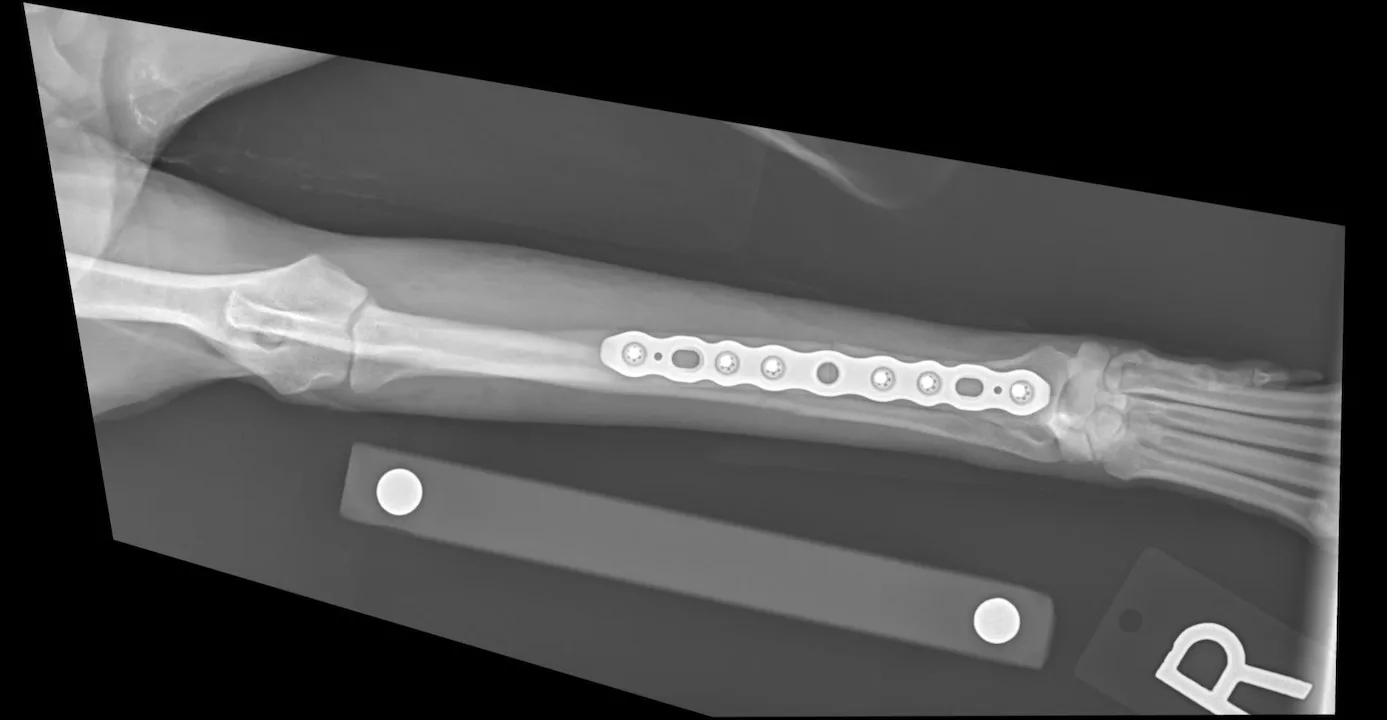
Bone plates are a highly versatile method of fracture repair. They can be used for any fracture that allows placement of 3 screws proximal and 3 screws distal to the fracture, engaging a total of ≥6 cortices.1 Plates can be applied in bridging, buttressing, or compressing configurations, depending on fracture configuration.1
The OrthoLine™ cuttable plate system is a versatile option that can accommodate a range of fracture patterns and anatomic requirements. Unlike most systems that require stocking multiple plate sizes and lengths, OrthoLine cuttable plates can be trimmed to the desired length, reducing inventory needs while maximizing flexibility. These plates are available in straight and T-shaped configurations, both allowing ≈7° to 8° of in‑plate bending before deformation. Sizes include 1.6 mm, broad 1.6 mm, 2.0 mm, and 2.4 mm. Although cuttable plates provide broad versatility, they are not available in all sizes needed for every patient or fracture type. The full OrthoLine system includes additional fixed-length plates and sizes that may be required to meet the needs of all breeds and fracture patterns.
4. External Skeletal Fixators
External skeletal fixators are used for various fractures, including open fractures. In open fractures, implants such as pins, nails, and plates can increase the risk for infection and osteomyelitis.1 External skeletal fixators stabilize fractures while minimizing implant-associated infection risk, as they are removed after healing. External skeletal fixation also allows for easy access to wounds for bandage changes.
External fixators are available in linear, circular, and hybrid configurations. Using external skeletal fixators in practice requires stocking a variety of materials to allow flexibility in construction, as these systems are custom designed for each patient’s needs.
Conclusion
General practitioners can successfully offer orthopedic services when they are committed to acquiring the necessary training, experience, and materials. To offer relatively comprehensive fracture repair services, a practice should stock 4 unique categories of orthopedic tools: IM pins with cerclage wires, interlocking nails, plates and screws, and external skeletal fixators. The OrthoLine cuttable plate system is a versatile solution that simplifies inventory requirements while accommodating a wide range of patient needs.