Inflammation: The Role of Hyperimmune Milk Factor (HIMF)
Sponsored by an educational grant from Veterinary Products Laboratories
Managing inflammation before it permanently damages tissues is essential to maintaining patient health. Traditional therapies—steroidal agents and nonsteroidal anti-inflammatory drugs (NSAIDs)—have profound anti-inflammatory effects. However, agents in both these classes have significant adverse side effects for which patients must be monitored. Indeed, steroid and NSAID administration must be limited in terms of dosage and length of treatment. In some cases, such therapy is precluded by concurrent conditions, and other patients may fail to respond to NSAIDs. For all of the above reasons, veterinarians often seek alternatives when the side effects of traditional anti-inflammatory therapies prevent their use or when multimodal therapy is desired.
MicroLactin® contains hyperimmune milk factor (HIMF)—a natural component of milk known to help manage inflammation. Frequent vaccination with a polyvalent vaccine stimulates dairy cows to produce HIMF. After being extracted and concentrated from the hyperimmune milk, the HIMF is commercially available as MicroLactin, the active ingredient in Duralactin® brand products.
MicroLactin may reduce inflammation by blocking the entry of neutrophils from the circulatory system into sites of tissue injury1 and by inhibiting neutrophil attachment to the endothelial wall.<sup2,3 sup>
In a placebo-controlled, double-blinded, randomized clinical trial,4 dogs treated with 1 gram of MicroLactin every 12 hours improved more frequently and to a larger degree than the placebo group. The dogs’ owners reported this improvement based on case-specific questionnaires and an overall score covering the 8-week study.
MicroLactin promotes and protects tight cellular junctions and interferes with the ability of neutrophils to adhere to the blood vessel wall, thereby blocking neutrophils from passing through capillary walls to sites of inflammation. This keeps more neutrophils within the bloodstream so fewer neutrophils participate in the inflammatory response. Therefore, Duralactin can help manage inflammation without the side effects of traditional anti-inflammatory treatments. Because of this, veterinarians can feel confident in recommending Duralactin early in the inflammatory process.
Chronic Pain
Robin Downing, DVM, DAAPM, DACVSMR, CVPP, CCRP
The Downing Center for Animal Pain Management
Duralactin® decreases inflammation and pain by a different mechanism than either corticosteroids or NSAIDs, making it an extremely important component of a management plan for my patients with chronic pain, mostly osteoarthritis. Inhibition of cytokines and leukotrienes in turn reduces migration of white blood cells to sites of inflammation. Duralactin is not a stand-alone tool for the majority of patients, but it has become an essential part of every chronic, maladaptive pain management plan that I put together.
Chronic Pain Regimen
Begin with an NSAID and Duralactin, as well as other components of a pain management strategy (eg, gabapentin, omega-3 fatty acids [EPA], polysulfated glycosaminoglycans [PSGAGs, Adequan®]).
At 10 to 14 days, reduce NSAID dose by 25% if patient is doing well.
Reassess patient in 10 to 14 days, but leave regimen unchanged if patient is still responding.
After 2 to 4 weeks, assess again, reducing NSAID again by 25% of original dose if response remains good. Dose is now half of the original.
Repeat Steps 3 and 4. Some patients are eventually able to be managed without any NSAID.
The advantages of reducing the dosage of NSAIDs are twofold: the potential for adverse effects is decreased, and a tool is then made available to provide relief from an acute flare of inflammation and pain, as with an injury.
Case History
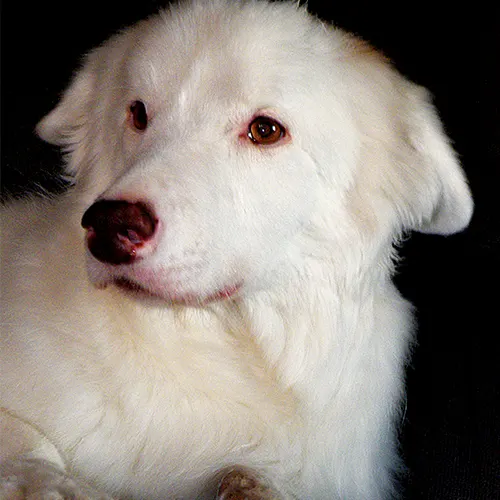
My own dog Opus, a crossbreed who was long and low to the ground, developed chronic maladaptive pain from osteoarthritis in his spine/back. As he also had Addison’s disease, his medication precluded using an NSAID. As a result of initiating Duralactin along with other components of a multimodal pain management plan, his pain score on palpation dropped from 6/10 to 1/10. He lived a long, full life despite his arthritis with the help of Duralactin and his other medications.
Keratomalacia in the Dog and Cat
Kerry Ketring, DVM, DACVO
All Animal Eye Clinic
Keratomalacia (“melting cornea”) is a true ocular emergency. Destruction of the corneal stroma, ie collagen fibers, and extracellular matrix by protease and collagenase produces a gray gelatinous appearance. There are multiple sources of these destructive enzymes including bacteria and inflammatory cells. The surface becomes irregular/elevated, producing the melting appearance, and will stain with fluorescein. This ulceration often leads to corneal rupture. Axonal irritation of the trigeminal nerve initiates an axonal reflex and dilation of iris and ciliary-body vessels, causing anterior uveitis with aqueous flare, often associated with hypopyon.
Factors contributing to keratomalacia include inappropriate use of topical antibiotics/corticosteroids. In cats with probable feline herpesvirus (FHV), Mycoplasma spp should be considered causative.
Treatment
Cytology and bacterial cultures are necessary in all cases. Pending results, the following regimen is instituted:
Antibiotics that are effective against Gram-negative rods both topically (q2–4h) and systemically
Protease inhibitor topically (serum preferred, q2–4h)
Atropine 1% topically (q24h)
NSAIDs systemically
Hyaluronate tear replacements (q4h, especially if keratoconjunctivitis sicca [KCS] has been previously present)
Duralactin® (animals ≤40 lb: ½ tablet q12h, 41–80 lb: 1 tablet q12h, 81+ lb: 1½ tablets q12h) to inhibit migration and infiltration of neutrophils
Cats, as appropriate: Medication for FHV orally. Doxycycline/azithromycin as additional agent against Mycoplasma spp (difficult to culture)
Owners are to be advised to treat around the clock and allow 5 to 10 minutes between topical medications.
The patient should be more comfortable in 48 hours. Antibiotics may change as dictated by cytology and culture. After 72 hours, with improvement, frequency of topicals can be reduced. With no improvement or if condition worsens, the diagnosis should be re-evaluated and treatment adjusted or the patient should be referred to an ophthalmologist. When fluorescein staining is negative, a topical corticosteroid is added to the treatment regimen to reduce vascularization/edema.
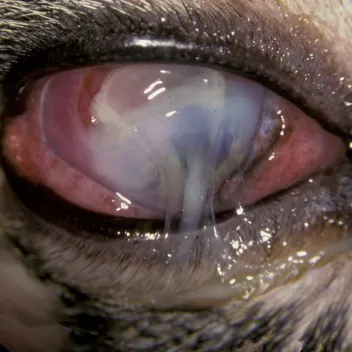
It is intuitive that if Duralactin decreases migration of neutrophils, then its use would be beneficial in treating this condition. I have been using Duralactin since the 1990s in my therapy for keratomalacia in dogs and cats and my clinical impression is that this regimen results in more rapid response and both clearer corneas and more visual eyes than without its addition. Fewer cases require surgery.
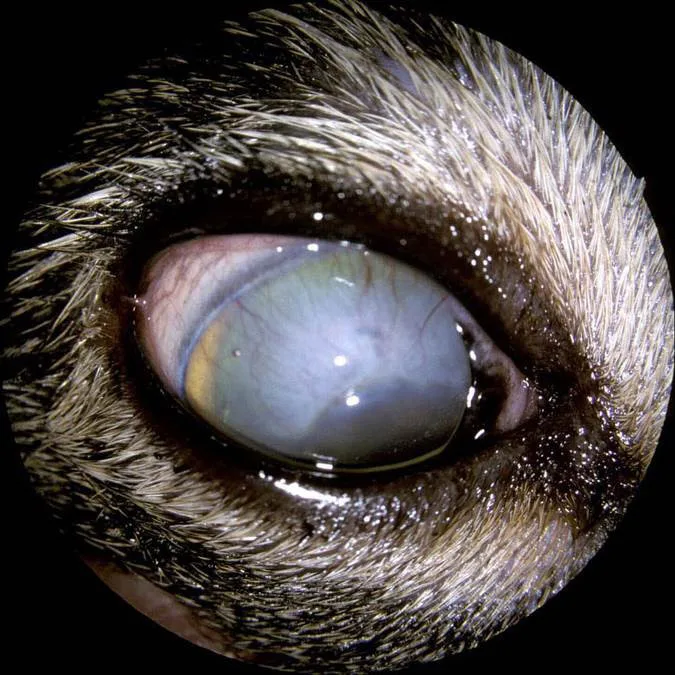
Case History
A 16-year-old domestic shorthaired cat had a 4 to 6 week history of upper respiratory infection and bilateral ocular disease that failed to respond to various oral and topical antibiotics. The cat was initially treated as outlined above. Following identification of Mycoplasma spp, the oral antibiotic was changed to azithromycin. The image at bottom is the same eye 34 days later. Topical corticosteroids were then added. Oral medication was also instituted for presumed FHV infection.