Factors Involved in the Progression of CKD
Harriet M. Syme, BSc, BVetMed, PhD, FHEA, MRCVS, DACVIM, DECVIM, Professor of Veterinary Internal Medicine, Royal Veterinary College, University of London, United Kingdom
Chronic kidney disease (CKD) is common in both the dog and cat. The traditional view is that an underlying primary insult initiates renal disease and once established, intrinsic progression is then likely to follow, often due to mal-adaptive mechanisms that in the short-term act to try to normalise glomerular filtration rate (GFR). These mechanisms serve as attractive therapeutic targets for delaying progression of renal disease. However, given that the underlying cause of kidney disease in dogs and cats often cannot be identified, even when histopathology is performed,1 it remains difficult to determine the relative importance of these putative mechanisms of progression, as opposed to further, uncharacterised, primary renal insults. Nonetheless, the success of certain treatments, such as ACE-inhibitors in humans with diabetic nephropathy,2 and feeding renal diets to dogs and cats with CKD,3-5 do confirm that delaying progression of renal disease is possible in certain circumstances.
After primary insult initiates renal disease, intrinsic progression is likely to follow, often due to mal-adaptive mechanisms that act to try to normalise glomerular filtration rate.
CKD is an important health problem in humans, affecting up to 10% of adults.6 There is evidence for considerable clustering of CKD within families and the heritability of GFR has been estimated at up to 36–75% in population-based studies.7 The disease has huge societal cost, particularly when it progresses to end-stage renal disease (ESRD) necessitating dialysis, resulting in high morbidity and mortality and great financial burden. Efforts have been made to identify the factors responsible for progressive decline in renal function in humans. For example a recent genome-wide association study (GWAS) of annual decline in estimated GFR had more than 63000 participants.8 Even with such a large sample size, only two novel loci were identified in that study. This is in spite of the fact that GFR is known to have high heritability and CKD clusters within families.7
Many studies of the pathophysiological processes underlying CKD progression in humans have relied on experiments performed in animals; primarily rodents, but sometimes dogs. Some of the most commonly employed research techniques are outlined in Table 1. It is evident that these studies have significant limitations as models of what happens in naturally occurring disease, not least because the onset of the renal functional impairment is usually slow in spontaneous disease and abrupt in the experimental models. Nevertheless, they have contributed to our understanding of renal disease. In particular, sub-total nephrectomy models have elucidated the role of glomerular hypertension in disease progression and the potential value of haemodynamic interventions, such as treatment with ACE-inhibitors. Unilateral ureteral obstruction has allowed the study of factors involved in the development of tubulointerstitial fibrosis.9 Currently, nephrology research interest is shifting slightly towards the role that proximal tubular injury plays in progressive renal disease.10 In part, this stems from the recent recognition that in addition to CKD being a risk factor for acute kidney injury (AKI), patients that have had an episode of AKI, even one from which they have appeared to have fully recovered, are at increased risk of subsequently developing CKD.11 It is suggested in humans that CKD is actually a ‘slow-moving AKI’ and this theory has been extended to dogs and cats.12
Risk Factors for Progressive CKD in Dogs and Cats
Azotaemia is not always progressive in dogs and cats. It is often said that while most dogs with established azotaemia will die of their renal disease, usually within a year, about half of all azotaemic cats will live long enough (often 2-3 years) to die of something else. Although the data to support these clinical observations is sketchy, there is some support for this from comparing the results of prospective diet studies in dogs and cats.3,4 One difficulty in comparing rates of disease progression in dogs and cats is that primary glomerular disease is rare in cats, and while it is uncommon in dogs too, it is encountered more frequently and as a sweeping generalisation, progression of this form of renal disease tends to be more rapid than with tubulo-interstitial disease.13
In one study of 213 azotaemic cats, progression (defined as an increase in creatinine of >25% from baseline) was documented to occur in 47% of cats within one year, 29% of cats with IRIS stage 2 disease and 63% of IRIS stage 3 CKD cats progressed to IRIS stage 4 before death.14 Interestingly, the risk-factors for disease progression appeared to be slightly different in cats with differing severity of disease, in cats with stage 2 disease PCV and urine protein-creatinine ratio (UPC) predicted progression, whereas in cats with stage 3 disease only plasma phosphate concentration was significantly associated. This observation may be a result of the small group sizes however, and needs to be verified in independent studies.
Proteinuria has been identified as a risk factor for progressive renal disease and/or all-cause mortality in studies of both dogs and cats with naturally occurring disease.15-18 This is in accordance with the findings of studies in humans.19 The role that systemic hypertension plays in progressive renal injury in dogs and cats is difficult to characterise, due to a high degree of confounding with the severity of proteinuria. Hypertension has been associated with shortened survival in dogs with CKD,20 however this effect was only evident when proteinuria was not included in the model. In cats with CKD and/or hypertension, when proteinuria is included in the analysis, blood pressure at diagnosis,17,18 or averaged over time during follow-up,17 does not remain as an independent predictor of survival. However, the relationship is complex since in hypertensive cats treated with amlodipine the cats in which hypertension was least well controlled (i.e. the cats with the highest blood pressure over time values) were also the cats that were most proteinuric.17
Renal Pathology
The histological lesions found in the kidneys of most cats with CKD are predominantly found within the tubulointerstium; glomerular lesions tend to be mild and are presumed to be a result of the glomerular hyperfiltration that occurs as a consequence of nephron loss and/or systemic hypertension.21 The tubulointerstitial changes include tubular degeneration and atrophy, interstitial inflammation consisting of infiltration of lymphocytes, plasma cells and macrophages, and lipid accumulation.22 These lesions are notably multifocal to segmental with the cellular and lipid infiltrate typically surrounding the degenerating tubules. Interstitial fibrosis accompanies these changes and is correlated with the severity of azotaemia.1,23 In dogs, the main focus of renal pathology studies has been specific breed-related conditions and in the characterisation of primary glomerular disease.24 Glomerulosclerosis, interstitial fibrosis, and tubular atrophy are reportedly common findings in aged dogs,25,26 but there is relatively little information available to correlate histopathological findings with clinical diagnoses or measures of GFR.
Research methods used in the study of renal disease progression
Limited use in transgenic mice models due to small renal size
Acute insult rather than chronic change
|
| Unilateral ureteric obstruction | Theoretically any, but commonly mouse |
Easily applied to transgenic mice
Contralateral (control) kidney for comparison
|
No urine produced for biomarker discovery
Reduced renal blood flow
Limited systemic consequences (not azotaemic)
|
| Genetic models | Theoretically any, but commonly mouse | Good models of specific diseases (e.g. Alport disease, polycystic kidney disease) but results may not be generalisable | Do not always re-capitulate the phenotype of other species (e.g. cystinosis) |
| Toxic nephropathies (e.g. cisplatin, doxorubicin) | Any (usually rats & mice) | Widely used as models of AKI, increasing interest in mini-AKI episodes as cause of CKD | Difficulty of injection (doxorubicin) |
| Streptozocin (Diabetic nephropathy) | Rats (usually) | Identified potential for ACEinhibitors in preventing diabetic nephropathy | Mice become diabetic but have limited renal pathology, limiting genetic studies |
| Ischaemia-reperfusion injury | Most commonly rats. Recent work on cats | Renal fibrosis is demonstrated as an outcome |
High morbidity
Variable and often mild tubule-interstitial changes
|
| Hypertensive models |
Spontaneously hypertensive rat (& other strains)
Two kidney, one-clip model (many species, including dogs)
| Development of focal segmental glomerulosclerosis | Lack other components |
Treatment Targets to Delay Progression of Renal Disease
Hyperphosphataemia
In patients with CKD, as GFR declines, the amount of phosphate that is filtered by the kidney decreases. Initially, if the decline in GFR is not that great, this effect can be overcome by reducing the amount of phosphate that is reabsorbed in the proximal tubule. This reabsorption of the filtered phosphate load is inhibited by the actions of parathyroid hormone (PTH) and fibroblast growth factor-23 (FGF-23). The excessive secretion of PTH in patients with CKD is referred to as renal secondary hyperparathyroidism. Traditionally this has been a focus for monitoring and treatment of patients with CKD. However, in human medicine attention has widened in the last decade to encompass changes in the concentrations of the other hormones as well as PTH. The preferred term for this syndrome is now CKD – mineral and bone disorder (MBD); this is defined as a systemic disorder of mineral and bone metabolism manifested by either one or a combination of the following:
Abnormalities of calcium, phosphorus, PTH or vitamin D metabolism
Abnormalities in bone turnover, mineralisation, volume, linear growth, or strength
Vascular or other soft tissue calcification
The relative importance of the various humoral factors that are responsible for CKD – MBD varies according to the stage of renal disease. This syndrome is of great interest in human medicine because increases in FGF-23 are correlated not only with reduced survival of patients with advanced CKD requiring dialysis,27 but also with much earlier stages of CKD.28 Additionally FGF-23 predicts cardiovascular mortality and this is true in patients without CKD, although the effect is more marked in those with poor renal function.29
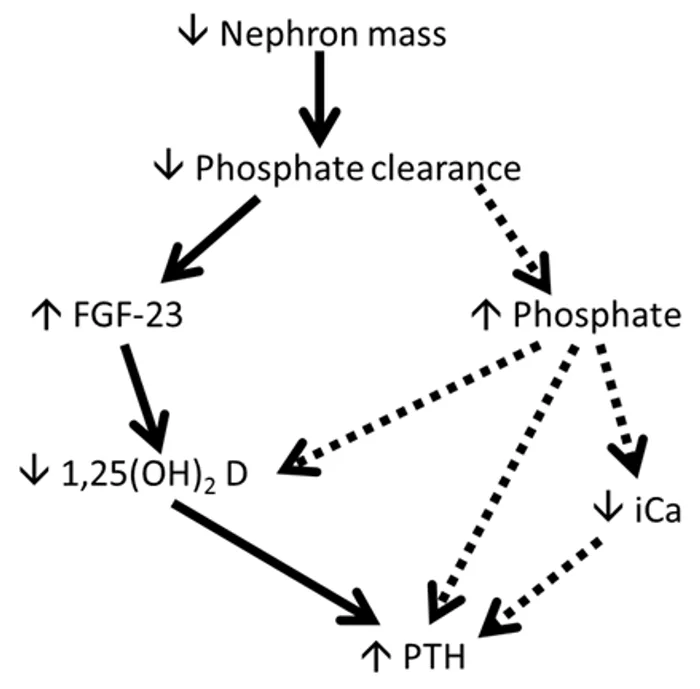
Simplified schematic illustrating the major adaptations/ maladaptations that occur as a result of decreased phosphate clearance in patients with CKD.Changes occurring with early/mild CKD. Changes occurring in the late stages/advanced CKD.
It has been known for some time that PTH concentrations are increased in cats with CKD, in many instances even when plasma phosphate remains within the laboratory reference range.30 Similarly, PTH concentrations have also been shown to increase with severity of renal disease in dogs.31,32 More recently it has been shown that FGF-23 concentrations are increased in cats,33 and dogs,31 with renal disease. As has been reported in human medicine, plasma FGF-23 is increased in early stage CKD in cats, prior to the onset of azotaemia.34 The fact that these hormones are increased in patients with non-azotaemic renal disease suggests that, even with mild decreases in GFR, there are physiological adaptations occurring to maintain phosphate homeostasis. The importance of FGF-23 in handling the cat’s phosphate load is supported by the observation that once the patient is azotaemic, if plasma phosphate is above the IRIS target range for that stage, FGF-23 is higher compared to those cases where plasma phosphate is within the target range.33
FGF-23 concentrations at initial presentation and diagnosis of CKD are predictive of progression of feline CKD and of all-cause mortality,35 similar to the findings reported in human medicine. A previous study by our group shown that plasma phosphate was predictive of progression of CKD,14 but when FGF-23 is included in the model it comes out as the strongest independent predictor of progression and displaces phosphate and PTH from the multivariate analysis.35
Dietary phosphate restriction, in the form of a diet designed for feeding to patients with CKD, has been associated with improved survival times in both cats,3,5,36 and dogs.4 Reductions in dietary phosphate intake have been shown to reduce both PTH37 and FGF-2338 concentrations in cats. In the future it will be interesting to see if setting particular targets for FGF-23 (and/or PTH) can further slow the progression of renal disease.
Renin-Angiotensin-Aldosterone System (RAAS)
Activation of both systemic and tissue-specific RAAS is widely accepted to occur in patients with CKD. Treatments targeting RAAS, including ACE-inhibitors, angiotensin receptor blockers (ARBs) and spironolactone have been extensively studied in animal models of CKD, and these drugs are widely used in both human and veterinary patients. This will be the subject of an accompanying lecture and is not discussed further here.
Renal Fibrosis
Regardless of the underlying aetiology of CKD, renal fibrosis, characterised by accumulation of extracellular matrix proteins including collagens and fibronectin, is thought to represent the final common pathway in progression of renal disease. As a result, a great deal of research has been directed at identifying the factors that are important in driving this process. Much of this has been performed using the model of unilateral ureteral obstruction in mice, which allows the insult (ligation of a ureter, either completely or partially) to be performed on transgenic animals and so to investigate the role of specific gene products on the ensuing inflammatory and fibrotic process. It is notable, however, that in spite of this research model being widely employed for over 20 years it has not, thus far, yielded any treatments for CKD that have made it to late-stage clinical trials.39 This has led some authors to argue that fibrosis may not be detrimental, but in fact could provide a scaffold for tissue repair, or else the fibrosis could simply be a marker for loss of proximal tubular cells that in health contribute half of the volume of the normal kidney.10
Transglutaminase-2 is an enzyme that cross-links collagen, stabilising the extracellular matrix. In the cat this enzyme has been shown to be up-regulated in renal tissue in patients with azotaemia and fibrosis.40 Inhibitors of transglutaminase, selective for the extracellular space, are effective in reducing renal fibrosis in rat models of diabetic nephropathy,41 and could in the future be used to slow the progression of renal disease.
Hypoxia
Hypoxia is a proposed mechanism for progression of CKD. It may cause renal injury through activation of renal fibroblasts to produce matrix and/or cause mitochondrial derangements resulting in cellular apoptosis. Hypoxia may occur in diseased kidneys through a number of different mechanisms. Patients with CKD are often anaemic due to a relative lack of erythopoietin production, increased blood loss and iron deficiency. Angiotensin-II may increase in patients with CKD, constricting the efferent arterioles, and so increasing glomerular capillary pressure, but actually decreasing blood delivery to the peritubular capillary network. Finally, in the presence of tubular inflammation and fibrosis the diffusion distance from the peritubular capillaries to the tubular epithelial cells may increase, contributing to hypoxia. In cats, epidemiological studies have identified anaemia (or reduced PCV) as a risk factor for reduced survival time and progression of renal disease.14,42 In humans with CKD anaemia worsens quality of life and increases mortality.43 However, while treatment with erythropoiesis stimulating agents (ESAs) is recommended when anaemia is severe, it is not usually recommended that haemoglobin concentrations are normalised, due to an increased risk of cardiovascular events. Treatment with ESAs has not been shown to delay progression of renal disease.44
Oxidative Stress
Oxidative stress increases in human patients with CKD.45 This is proposed to be because of the high metabolic activity of renal tubular cells resulting in production of reactive oxygen species (ROS) together with a relative deficiency of anti-oxidant defence mechanisms. As a result it is proposed that damage to DNA and lipids may occur, resulting in cellular injury and ultimately stimulating inflammation and fibrosis through activation of NFκβ. However, treatment with different antioxidants has yielded variable results, leading to a Cochrane review to conclude that there was no evidence for their benefit.46
Indoxyl sulphate
Indoxyl sulphate is a product of tryptophan metabolism that accumulates in patients with reduced renal function and is incriminated in causing progression of CKD. It is classified as a uraemic toxin.47 Tryptophan from protein in the diet is cleaved to indole by the gut microbiota, primarily in the distal colon. Synthesis of indole may be increased in patients with CKD due to dysbiosis. Indole is then sequentially oxidised and sulphated within the liver, yielding indoxyl sulphate. Indoxyl sulphate causes oxidative stress, increases fibrosis and activates the local RAAS. Indoxyl sulphate concentrations increase with IRIS stage of CKD in both dogs and cats.48 Furthermore, a recent study found that indoxyl sulphate concentrations were higher in dogs and cats with subsequent progression of renal disease.49