Dracunculiasis in Dogs
Michael J. Yabsley, MS, PhD, FRES, University of Georgia
Christopher A. Cleveland, MS, PhD, University of Georgia
Heather D.S. Walden, MS, PhD, University of Florida
Visualizing Dracunculus spp
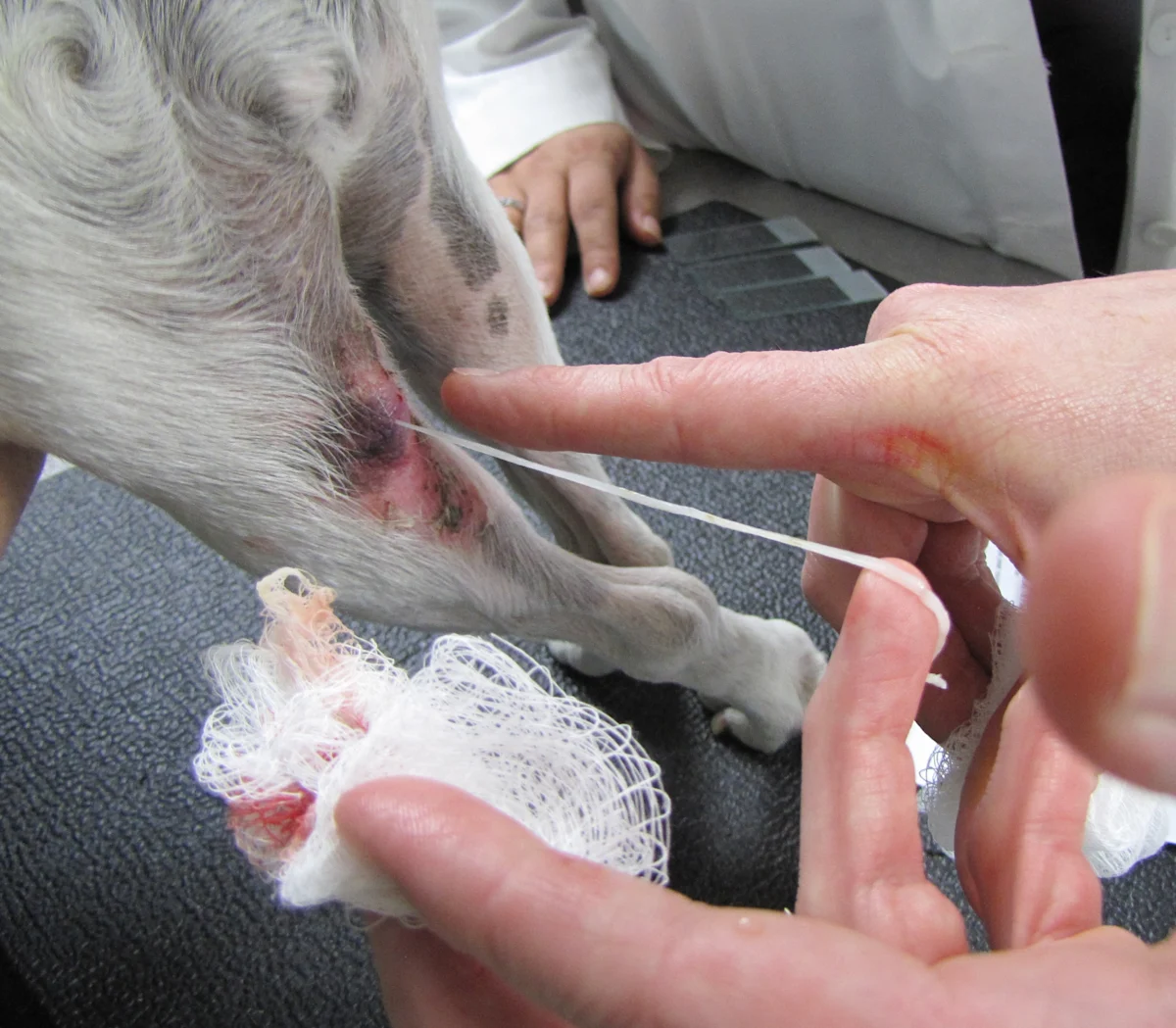
FIGURE 1 Lesion with a parasite (identified as Dracunculus sp via PCR and DNA sequencing) emerging from the pelvic limb of a domestic dog in Minnesota
Understanding Dracunculus spp Infection
The most likely causative agent of Dracunculus spp infections in dogs and cats is Dracunculus insignis, which primarily infects wild carnivores (eg, raccoons, mink, muskrats, foxes, coyotes, otters) but can also infect domestic dogs and cats.1,2 North American dracunculiasis also includes infection with Dracunculus lutrae, which primarily infects river otters, 2 unnamed species (one primarily infecting river otters and the other primarily infecting both river otters and opossums), and Dracunculus sp PantanalBr in Florida panthers.1,3-5 The life cycle of all Dracunculus spp requires aquatic copepods as intermediate hosts; frogs and fish may serve as paratenic hosts for some species.6,7 Several Dracunculus spp, including D sp PantanalBr, have been reported in dogs in Europe, Africa, and South America.8-11
Diagnosing Dracunculus spp Infection
Infected domestic dogs and cats are typically presented with limb swelling, but the parasite can be present in any location. The area may be swollen, ulcerated, alopecic, pruritic, or painful and may have a visible worm emerging or hanging from the lesion.
For diagnosis, an adult worm or larvae may be observed on cytology of an aspiration sample, during biopsy, or during surgical exploration of the wound. In cases in which the worm was emerging prior to presentation, the larvae may have already been expelled; lack of larvae thus does not rule out Dracunculus spp infection. Species identification requires molecular characterization via PCR and DNA sequencing performed in a specialty laboratory; however, the presence of 600- to 900-µm larvae with very long, pointed tails is diagnostic for Dracunculus spp.1
Differentials in dogs include bacterial or fungal abscesses, neoplasia, foreign body reactions, or infection with other subcutaneous parasites (eg, nematodes [Dirofilaria immitis, Acanthocheilonema reconditum, Cercopithifilaria bainae, Onchocerca lupi], cestodes [Spirometra spargana]).12,13
Although A reconditum, C bainae, and aberrant migration and development of D immitis can result in swelling similar to Dracunculus spp, these parasites contain microfilariae that are morphologically distinct from the long, pointed-tailed larvae of Dracunculus spp.
Periocular lesions may occur secondary to O lupi, which also contain microfilariae similar to Dirofilaria spp.
The larval stage of Spirometra spp (ie, spargana) found in canine subcutaneous tissues lacks characteristics typical of nematode parasites.
Other subcutaneous parasites (eg, Dirofilaria repens, Dirofilaria asiatica [previously, Dirofilaria sp hongkongensis], Brugia spp) are possible in dogs with a history of travel or that live outside of North America, but filarial worms would contain microfilariae.12,14,15
What Is the Clinician’s Role in Canine Importation?
Clinicians are often the first line of defense against introduction of novel and zoonotic pathogens and should therefore be aware of and screen for infectious pathogens in imported dogs. Early identification of these pathogens can reduce transmission to domestic dogs and/or caregivers, veterinary team members, and the wider community.
Read more about managing imported dogs and the crucial role clinicians play in safeguarding both animal and public health.
Treating Dracunculus spp Infection
Treatment includes surgical removal of the worm; prognosis is excellent. Care must be taken to ensure the worm does not break during removal, as this can lead to inflammation and irritation. There is currently no effective anthelmintic for treatment of Dracunculus spp. Antibiotics for secondary bacterial infections and anti-inflammatory drugs may be useful in certain cases, especially if part of the worm is not extracted.
Prevention includes ensuring animals avoid drinking water that may contain copepods and avoid consumption of raw fish and amphibians.
Zoonotic Potential of Dracunculus spp
Only Dracunculus medinensis in Africa and an unnamed Dracunculus sp in Vietnam are known to be zoonotic.16
The Companion Animal Parasite Council maintains up-to-date guidelines for numerous parasites, including Dracunculus spp.