Checklists: An Answer to Avoiding Mistakes

You have asked…
Can medical and surgical checklists help prevent mistakes in my clinic?
The expert says…
Human error is inevitable, particularly under stressful work conditions.1,2 As stress, fatigue, and the complexity of a situation collectively increase, cognitive function decreases and errors can occur.2 Hospitals and operating rooms are highly stressful, complex environments that require precision while completing multiple actions, thereby leaving ample room for mistakes.
Outlining the Problem
From 45,000 to 90,000 Americans die each year as a consequence of medical mistakes, making these errors the eighth leading cause of death in the United States.3 Mistakes occur in 1% of actions performed by doctors, nurses, and other hospital staff, accounting for 2 mistakes per patient per day.4 More than half of reported medical mistakes are surgical.5
As in human medicine, medical and surgical mistakes occur in veterinary medicine, although the incidents may not be as strictly reported or widely publicized.
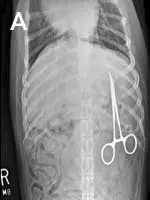
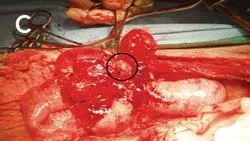
Figure 1. Leaving surgical instruments and supplies such as a hemostat (A) and sponges (B and C, circles) in patients is just one type of mistake that can be avoided by following a surgical checklist.
It is easy to understand how mistakes occur when considering the complexity of medicine. Surgical procedures (routine or emergent) require coordination of an entire team, starting from the moment a pet enters the clinic.
Finding the Solution
The introduction of surgical checklists has had a profound impact on human medicine. A recent study published in the New England Journal of Medicine demonstrated that a simple checklist can significantly decrease the number of surgical mistakes.6 Rates for complications (eg, for surgical site infections, blood loss, mortality) were compared before and after implementation of surgical checklists in human hospitals around the world.7
The results were dramatic: Use of a checklist decreased the mortality rate in surgical patients by nearly 50%.6 Surgical site infections decreased from 11.2% to 6.6%, while blood loss volume greater than 500 mL decreased from 20.2% to 13.2%.6 Veterinary professionals can learn from this study as well as by reading The Checklist Manifesto by Dr. Atul Gawande.6
Related Article: Developing Your Practice Team for Peak Performance
Making Your Checklist
At the University of Florida, we instituted a surgical checklist based on the World Health Organization (WHO) Safe Surgery Checklist developed by Dr. Gawande and his team. This checklist is basic, allowing practioners to tailor it to individual needs.6
Developing a checklist can be accomplished in 5 steps8:
Content creation and formatting
Timing
Trial and feedback
Formal testing and evaluation
Local modification
The checklist should be short, easy-to-read, and succinct, taking no longer than a few minutes (or even 60 seconds) to complete. Individuals will likely add and delete portions of the checklist as it is implemented.
See an example of a Veterinary Surgical Checklist
When creating the checklist, the first step is to identify a weakness and target your clinic’s problem area(s). To improve on weaknesses, consider developing a checklist with 3 general sections—check-in, surgery, and sign-out:
Check-in may include signed client permission forms, preoperative blood work, intravenous catheter placement, etc.
Surgery may be brief and include patient identification, preoperative instrument and supply counts, and confirmation of incision site.
Sign-out may include postoperative instrument and sponge counts, specimen labeling (if appropriate), and Elizabethan collar placement.
One person nominated as the checklist coordinator (not the veterinarian) should check off the tasks/items as the pet moves through the hospital. The checklist coordinator may meet some initial resistance, especially when beginning the checklist system, but he or she must be willing to stop a procedure until the entire team has adequately completed the tasks or actions on the checklist.
Everybody on the surgical and/or medical team needs to be open to change; local modification is an important part of checklisting. For example, it may not be necessary to check whether a specific hip implant is in stock, but performing a pre- and postoperative supply count is important. Likewise, checklists can be used for nonsurgical tasks, such as placing an IV or urinary catheter or ensuring that all medical procedures are performed appropriately.
Related Article: Good Communication Isn’t Always What You Think
Timeout and Final Check
After a patient has been prepped but before surgery begins, a “timeout” gives the team a chance to pause and reflect on the tasks/actions ahead of them. If appropriate (eg, in large hospital settings), team members can introduce themselves and identify their roles. In addition, the patient’s identity should be reconfirmed, the procedure reiterated, the equipment checked, supplies and instruments counted, and potential problems anticipated and discussed (_see Key Checklist Tasks below)_
Before wound closure, the final section of the checklist should be addressed: Postoperative instrument and sponge counts need to be completed, any specimens obtained during surgery gathered and labeled, equipment concerns addressed, and the postoperative plan discussed among team members.
Improving Communication and Teamwork
One of the major benefits of a surgical or medical checklist is communication, as it helps transform a group of people into a team. A checklist encourages team participation by following a systems approach that assumes individuals may err; however, by introducing specific measures, such errors can be prevented from causing harm. When a group functions as a team, individuals feel empowered and motivated to succeed.
A study conducted 1 year after initiation of a checklist demonstrated that participants had improved their interdisciplinary team building, increased their sense of responsibility, and prompted a positive change in failure culture.9 At our institution, we encourage students to speak up if the chief of surgery has breached sterile technique and technicians to alert the surgeon before operating on the wrong limb. By expecting more from one another and ourselves, we can prevent mistakes.
Checklist Updates
Your checklist should be reviewed periodically. For example, about 1 month after implementing a checklist, the entire team (new and old members alike) should identify unnecessary or frequently forgotten steps. Discuss where improvements can be made and add to or delete from the checklist as necessary.
Although surgical checklists may initially receive mixed reviews from surgeons and surgical staff, checklists have proven useful to medical professionals. As part of the study performed by Dr. Gawande’s group, a survey conducted 3 months after the checklist system had been initiated revealed that 80% of nurses, surgeons, anesthesiologists, and other staff members believed the checklist was easy to use, did not take long to complete, and improved patient safety.7 Furthermore, 78% of respondents reported that an error had been prevented. When asked whether the respondents would want a checklist to be used if they were undergoing surgery, 93% said yes.
Related Article: Client Complaints, Errors, & Accountability
The Bottom Line
There is little reason for veterinarians to expect less than what checklists have brought to human medicine: a 50% reduction in mortality, correct and timely administration of preoperative antibiotics in 83% of patients, and accurate sponge counts in 97% of patients.6 A simple checklist can reduce errors, enhance safety, and improve outcome.
Key Points
Many private practices have a small staff and high case load. Because coordination of different departments may not be a factor in a small practice, a concise checklist focusing on problem areas is necessary.
At one hospital (University of Florida), the OR technician is the checklist coordinator and reads the checklist aloud. Once the surgery section of the checklist is completed, the surgery may begin. Before wound closure, the postoperative section of the checklist is reviewed.
This article is part of the One Health Initiative
KELLEY M. THIEMAN, DVM, MS, is a clinical assistant professor in small animal surgery at Texas A&M University College of Veterinary Medicine & Biomedical Sciences. Dr. Thieman has a special interest in soft tissue surgery and has presented surgical checklists at the annual NAVC Conference in Orlando, Florida. Dr. Thieman completed a small animal medicine and surgery rotating internship at University of Tennessee, after which she attended University of Florida for a combined surgical residency and graduate program. Dr. Thieman graduated from University of Missouri in 2006.