How to Choose Artificial Intelligence Radiographic Interpretation Tools
Diane Wilson, DVM, DACVR

Sponsored by Antech Diagnostics
Artificial intelligence (AI) can be a useful tool in diagnostic imaging that can help streamline workflows, support clinical decision-making, and improve practitioner confidence.1 With a growing number of tools available for clinical use, selecting the right one is critical; the right AI tool can help boost productivity and reduce cost, whereas the wrong one can complicate workflows and cause frustration for the veterinary team. Moreover, lack of user understanding and clinical oversight of AI tools can result in patient harm.2
Understanding how AI tools differ and what features to look for can help practices make more informed decisions when selecting an AI diagnostic imaging tool. There are 4 foundational elements to consider when determining whether an AI diagnostic imaging tool will be reliable when used in clinical practice:
Domain experts: Veterinary radiologists who ensure the AI is trained on clinically relevant findings
Data scientists: The technical team responsible for building, validating, and refining the AI algorithms
Vast amounts of data: Large, diverse imaging datasets that allow the AI to provide accurate information across breeds, body types, and pathologies
Education of the end user: Training and support that help the clinical team interpret and apply AI outputs with confidence
Domain Experts
An AI domain expert is a specialist with deep knowledge in a specific field who collaborates with technical teams to ensure AI solutions are accurate, relevant, and contextually aware.3 When it comes to veterinary imaging AI tools, domain experts are board-certified radiologists, and their involvement should not be limited to algorithm development alone. A reliable tool requires their involvement every step of the way, from building the ground truth data through the life of the tool. Ground truth data refers to verified data (in the context of this article, radiographic images) used for training, validating, and testing AI models.4 Ground truth data is the foundation the AI model learns from. When radiologists annotate these images, the AI is trained on accurate, clinically meaningful interpretations. When that labeling is performed by nonimaging experts or generated from currently available programming models alone, it will significantly hinder an AI tool’s ability to reach near-perfect accuracy. After tool creation, board-certified radiologists also play an important role in educating the veterinary community on the best use and best practice of this new technology.5
Data Scientists
Data scientists are problem solvers who use data to create solutions. Behind every AI imaging tool is a team of data scientists who shape how the AI interprets images, determines which patterns it learns to recognize, assesses image quality, and handles the variability seen across real-world clinical cases. Their contribution goes well beyond the ability to understand code. Data scientists with significant training and experience in AI are crucial to creating algorithms that have both highly specific and highly sensitive image interpretation.
Vast Amounts of Data
When it comes to training a reliable AI imaging tool, data volume matters. The AI must be trained using expertly labeled cases that cover a wide range of findings, breeds, body types, and image qualities to learn how to accurately handle real-world cases. The size of the dataset needed for a given finding or feature varies. Small dataset sizes have been identified as a key limitation of AI diagnostic models in veterinary imaging, with larger multicentric training datasets associated with improved model generalizability.6,7
Education of the End User
AI-driven diagnostic image interpretation tools are a form of technology that is new to the veterinary profession. Developers have a responsibility to provide clear, accessible information about how the tool was built, what it was trained to detect, and where its limitations lie before allowing it to be used in patient care. Similarly, general practitioners and nonimaging specialists who use these tools should understand the basics of how the tool was developed and both its uses and limitations before bringing the tool into patient care.
Which Tool Is Best?
Ultimately, only the managing practitioner or veterinary team can determine which AI tool will be right for their practice, but that decision can be made easier with a clear framework. A good starting point is to look at how each of the 4 key elements was integrated into each particular tool during development and carried through after the tool’s release. From there, learning the features of each product and whether they align with the needs of the practice can help narrow the field. Familiarity with and trust in an AI diagnostic imaging tool are essential for veterinarians to benefit from its use in practice,1 and a trial of an AI system can be beneficial in understanding the real-world limitations of an AI diagnostic imaging tool and how best to incorporate it into daily practice.
The following questions can help guide research in different product options and inform conversations when determining the option that fits best:
Were board-certified radiologists used in the development of individual features of the AI tool?
Were the board-certified radiologists comprehensively involved in creation of ground truth data, testing, and postrelease quality control?
Are board-certified radiologists readily available 24/7, should the veterinary team have any questions or concerns about AI-generated reports?
What is the level of experience of the data science team? Do they use a wide range of publicly available and proprietary tools to develop models?
What findings and features are available?
What is included in the AI-generated report? Do findings only include generic differentials, or do they include meaningful, patient-targeted assessments?
How often are upgraded and new features released?
Where does the training data come from for each feature? How large are the ground truth datasets, and what percentage of each dataset is created using augmentation techniques as compared with confirmed or handlabeled cases?
How is the advertised accuracy calculated, and has it been validated against an independent dataset?
What educational resources (eg, videos, presentations, quick-reference cards) are available to help users understand the tool, and is live technical support available 24/7?
Considering the answers to the above questions and matching them with the practice’s needs can help in choosing the best AI interpretation tool for the practice.
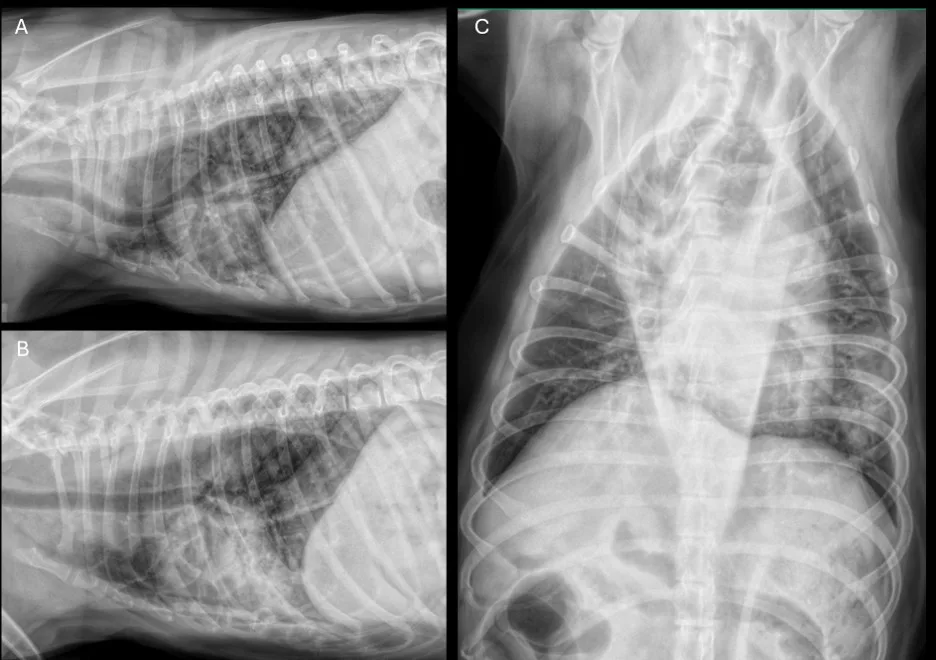
A 3-view thoracic study on an 11-year-old crossbreed dog with clinical signs of coughing and lethargy reported (A, left lateral projection; B, right lateral projection; C, ventrodorsal thoracic projection). In this case, RapidRead correctly identified esophageal dilation, alveolar, unstructured interstitial, and bronchial pulmonary patterns. Identification of these patterns can support the managing veterinarian with confirmation of their findings or identification of findings that may not have been identified. RapidRead can also provide clinical assessments based on findings and history and, in this case, provided assessment that bronchopneumonia secondary to aspiration is likely.
Making the Most of Artificial Intelligence
Choosing the AI image interpretation tool that best matches a practice’s needs is the first step toward getting the most out of the technology. Like any clinical tool, AI image interpretation tools come with their own set of benefits and limitations.2,7 AI tools are a powerful complement to clinical judgment, not a replacement for radiologists, and practices that approach them with that perspective will have the best success in using these tools to improve patient care and clinic workflows.
KEY TAKEAWAYS
Not all AI imaging tools are built the same, and evaluating how a tool was developed is just as important as evaluating what it can do.
Board-certified radiologists should be involved at every stage of AI tool development, from building the training dataset through ongoing quality control after release of the product.
Reliable AI models require large, expertly labeled datasets; the quality and volume of training data directly determine how accurately the tool will perform in real-world clinical settings.
AI is a powerful complement to clinical judgment, not a replacement for evaluation by veterinarians, including radiologists. Practices that approach it with that mindset will be the ones who get the most from AI imaging technology.
Looking to start using an AI diagnostic imaging tool in your practice? Learn about RapidRead here.
