Marijuana Toxicosis in a Labrador Retriever
Jill, a 2-year-old spayed Labrador retriever, was presented to emergency services following a play-date at a friend’s house earlier that day. Jill was reported to have vomited one time and was lethargic as the play-date ended. When the owner picked Jill up, she found her pet to be stiff but ambulatory. Over the course of the evening Jill was reported to be sleepier than usual and did not appear to want to eat. One hour before presentation, Jill she became ataxic, was falling over, and ultimately was unable to stand.
Examination
At physical examination, Jill was alert but quiet and bradycardic (heart rate was 50) with moderate femoral pulses. The lungs ausculted within normal limits, and the abdomen was soft and non-painful. Body temperature was normal (101.2° F). Jill was neurologically inappropriate, unable to stand, and intermittently stiff in all four limbs. A decreased conscious proprioception in all limbs (knuckling feet) was present, and pupils were dilated but responsive.
A quick bloodscreen database (PCV/TS, BG, electrolytes) was within normal limits.
Diagnosis
Prompted by the patient’s young age, history, and clinical signs, a urine illicit drug screen (Figure 1) was performed. The drug screen was positive for THC (marijuana).
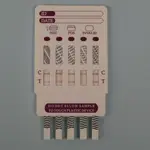
The active ingredient in marijuana is 9-tetrahydrocannabinol (THC). Following exposure, common examination findings in veterinary patients include incoordination, listlessness, stupor, mydriasis, bradycardia, and urinary incontinence. GI signs are less common, as THC is believed to reduce nausea. Onset of signs depends on the exposure form and exposure dose ranging from 5 minutes to several days. Because THC is stored in the body's fat deposits, effects of marijuana ingestion can last for days.
Treatment
As the exposure was likely 12 hours prior to evaluation, decontamination with emesis was not performed. Often emesis is induced if ingestion was within 30 minutes. Activated charcoal was not administered on presentation as she was showing signs of mental depression and other neurological behavior which would increase the risk of aspiration.
For this reason, Jill was admitted to the hospital for monitoring and supportive care. A routine CBC and serum biochemistry panel was performed; no abnormalities were found. While in the hospital, Jill received IV fluids and over 24 hours became gradually more responsive. Once more responsive, Jill received a single dose of activated charcoal with a cathartic (sorbitol) and a dose 8 hours later without a cathartic. With continued improvement, Jill was discharged 36 hours following presentation normal in evaluation.